
Best Franchises Under $300K: Premium Concepts Within Reach
At the $200,000 to $300,000 investment level, franchise options expand into territory that combines physical presence, brand credibility, and genuine scalability. This range is where many of the most compelling franchise concepts in pet services, premium fitness, professional services, and specialty retail operate. It is also where the quality gap between well-run and poorly-run franchise systems becomes most apparent.
What Changes Between $200K and $300K
The additional $100,000 buys meaningful upgrades to business infrastructure. At the $200K level, you're often looking at minimal buildouts in B-grade retail spaces. At $300K, you're getting properly designed interiors in A or B-plus locations, more sophisticated technology systems, higher-quality equipment, and a larger initial marketing budget to drive opening-month traffic.
This investment range also tends to attract more sophisticated franchise systems. The franchisors operating at this level have typically been in business longer, have more established training programs, and provide more robust ongoing support. The franchise fee, often $35,000 to $50,000, represents a smaller percentage of the total investment, with more of your capital going toward revenue-generating assets rather than access rights.
Perhaps most importantly, franchises at this level tend to generate higher average revenue per unit. While a $100K franchise might produce $200,000 to $400,000 in annual revenue, concepts in the $250K to $300K range frequently target $500,000 to $1,000,000 in annual revenue. The investment is larger, but the return potential scales disproportionately.
Pet Services: A Category That Fits Naturally Here
The pet industry's growth past $157 billion has created a robust franchise landscape in the $200K to $300K range. Dog training, pet wellness, grooming studios, and hybrid pet service concepts operate at this investment level with business models built on recurring revenue and high customer retention.
Dog training franchises represent a particularly interesting segment. Unlike pet retail (which competes with Amazon) or pet daycare (which requires significantly larger spaces and staff), training operates in compact spaces with lean staffing and creates deep customer relationships. A dog training client typically enrolls for 6 to 12 weeks of classes and often continues with advanced programs, totaling hundreds or thousands of dollars in lifetime value.
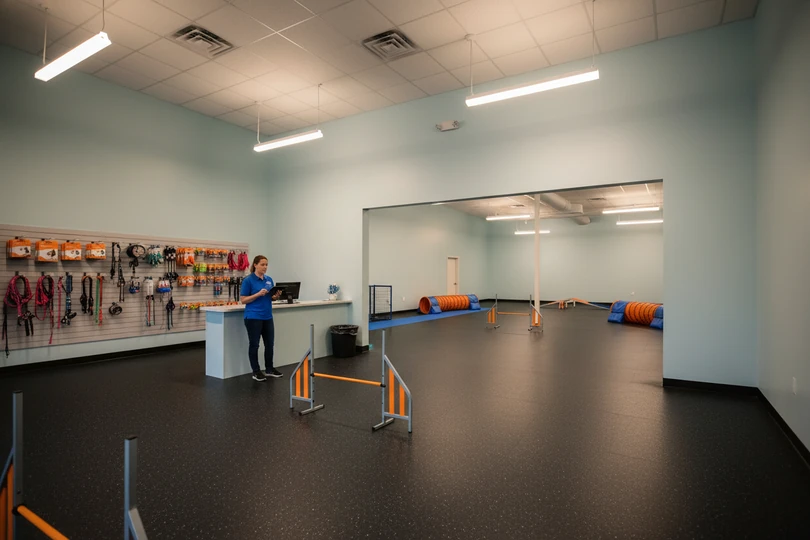
Zoom Room, ranked number one in dog training by Entrepreneur's Franchise 500 in 2026, operates within this investment range at $302,000 to $465,000. The model uses approximately 3,000 square feet and typically runs with just two staff members per shift, keeping labor costs manageable. The class-based revenue model means multiple customers generate revenue simultaneously, which creates fundamentally different unit economics than one-on-one service businesses.
When evaluating pet franchises in this range, compare the revenue model (classes vs. one-on-one, memberships vs. packages), space requirements, staffing complexity, and the brand's positioning within the local competitive landscape. A concept that fills a genuine gap in the market is worth more than one entering an already crowded space.
Premium Fitness and Wellness Concepts
The upper end of this range opens access to premium fitness and wellness franchises: functional training studios, recovery and wellness centers, medspas, and hybrid health concepts. These brands typically charge higher membership rates ($150 to $300 per month versus $30 to $60 for budget gyms), which supports higher revenue per member and better margins.
The premium fitness category is growing precisely because commodity fitness has become a race to the bottom. Planet Fitness and similar brands have conditioned consumers to expect $10-per-month gym memberships, making it nearly impossible for mid-market gyms to compete on price. Premium concepts sidestep this entirely by selling outcomes, community, and experience rather than equipment access.
Recovery and wellness concepts, including cryotherapy, IV therapy, red light therapy, and compression therapy, are newer entrants in this range. Some are growing rapidly, but the category lacks the track record of established fitness models. Evaluate these opportunities with extra scrutiny: look for franchises with at least three years of franchisee performance data, not just corporate pilot locations.
Professional Services and B2B Concepts
Staffing agencies, commercial cleaning operations, business services, and professional consulting franchises in the $200K to $300K range often target B2B revenue, which has different characteristics than consumer-facing businesses. B2B relationships tend to be stickier (commercial cleaning contracts run 12 to 36 months), higher in value (a single staffing client can represent $50,000 or more in annual revenue), and less sensitive to seasonal patterns.
The staffing industry alone is worth over $200 billion in the United States. Staffing franchises at this level typically focus on a specialization, such as light industrial, administrative, healthcare, or IT staffing, that allows them to develop expertise and command higher margins than generalist agencies. The operating model is primarily an office with recruiters and account managers; there is no retail buildout required.
The challenge with B2B franchises is the sales cycle. Landing your first ten commercial accounts can take six to twelve months, and revenue ramps gradually rather than launching with a grand opening rush. Make sure your working capital accounts for a longer path to break-even than a consumer-facing business might require.
Specialty Retail With Defensible Niches
Specialty retail franchises in this range include children's resale shops, hobby and craft stores, salon suites, and niche food concepts (not full-service restaurants). What distinguishes successful specialty retail from general retail is a defensible niche: a product or service category that Amazon and big-box stores cannot replicate easily.
Salon suite franchises are a notable model. Rather than operating a salon, you build and lease individual suites to independent beauty professionals. The model generates rental income with minimal operational complexity, as each suite operator is an independent contractor managing their own clients and schedules. Total investments typically fall between $200,000 and $350,000, and occupancy rates at mature locations often exceed 90 percent.
Children's resale is another category with strong economics. Parents need to outfit growing children constantly, and sustainability-conscious consumers increasingly prefer secondhand. These franchises benefit from a supply advantage: parents actively want to offload outgrown clothing and gear, so inventory acquisition costs are minimal.
Building a Comparison Framework
Comparing franchises across different categories at the same investment level requires a standardized framework. Here are the metrics that matter most:
Revenue per square foot. This normalizes revenue across different-sized locations. A $500,000 business in 1,500 square feet is fundamentally more efficient than the same revenue in 5,000 square feet.
Revenue per employee. Measures how efficiently the business converts labor into revenue. Concepts with higher revenue per employee generally have better margins and simpler management challenges.
Customer acquisition cost and lifetime value. How much does it cost to acquire a customer, and how much do they spend over their entire relationship? Businesses with low acquisition costs and high lifetime value (like dog training, where a single client often spends over a year in progressive programs) have structural advantages.
Recurring revenue percentage. What share of revenue comes from subscriptions, memberships, or repeat bookings versus one-time transactions? Higher recurring revenue means more predictable cash flow and higher business valuation multiples when you eventually sell.
Break-even timeline. In this investment range, 12 to 18 months to monthly break-even is typical. Faster is better, but be suspicious of claims under six months unless the data is verified through FDD Item 19.
Frequently Asked Questions
- Pet services (training, wellness), premium fitness studios, professional staffing, salon suites, and specialty retail concepts are among the strongest categories in this range. The best franchise for you depends on your market, interests, and skills. Focus on concepts with strong franchisee satisfaction, transparent financial performance data, and a business model that creates recurring revenue rather than depending on one-time transactions.
- Yes, several dog franchise concepts operate within or just under this budget. Dog training franchises like Zoom Room start at $302,000, while grooming and pet wellness concepts can be lower. Dog daycare franchises, by contrast, typically require $500,000 to over $1 million due to larger space requirements and heavier staffing. The type of pet service matters significantly for investment requirements.
- Common financing paths include SBA 7(a) loans (typically 10 to 20 percent down), conventional business loans, ROBS 401(k) rollovers, home equity lines of credit, and combinations of these. Many franchisees at this level use SBA financing for 70 to 80 percent of the investment and contribute personal savings for the remainder. Pre-qualification with an SBA-preferred lender before selecting a franchise can clarify your realistic budget.
- Service-based franchises with low overhead and recurring revenue tend to reach payback fastest. Concepts with lean staffing, compact spaces, and class-based or membership revenue models can achieve payback in 24 to 36 months. However, payback period varies significantly by market and operator. Study Item 19 data and talk to franchisees in comparable markets for realistic projections rather than relying on system-wide averages.
- Both are legitimate wealth-building strategies with different profiles. A franchise offers active income, potential tax advantages of business ownership, and the ability to scale through additional units. Real estate offers passive income and appreciation but typically requires less daily involvement. Many successful investors eventually hold both. The right choice depends on whether you want to build a business or a portfolio, and how much time you want to dedicate to management.
What are the best franchises between $200K and $300K? +
Is $300K enough for a dog franchise? +
How do I finance a $300K franchise? +
What franchise has the fastest payback period at this level? +
Should I invest $300K in a franchise or real estate? +
The Number One Dog Training Franchise in America
Zoom Room is ranked number one in dog training by Entrepreneur's Franchise 500 for 2026. With a total investment of $302,000 to $465,000, a compact 3,000-square-foot model, and lean staffing of just two people per shift, it represents an efficient entry into the $157 billion pet industry.
Request InfoThis is not an offer to sell a franchise. An offer can only be made through a Franchise Disclosure Document. Financial performance representations are available in Item 19 of our Franchise Disclosure Document. Contact us to request our FDD.