
You Have $150K in Liquid Capital. Here's What That Opens Up in Franchising.
"I have $150K saved up and want to buy a franchise." This is one of the most common starting points in franchise investing — and it is a solid one. Let's break down what $150K liquid really means, how to stretch it with financing, and which franchise categories deserve your attention.
What $150K Liquid Capital Actually Means for Franchise Investing
Liquid capital is the cash (or near-cash assets) you can access quickly — savings accounts, brokerage accounts, money market funds. It does not include home equity, retirement accounts you cannot touch without penalties, or money your spouse is not willing to invest.
When a franchisor says they require $150K in liquid capital, they are looking for proof that you can cover a meaningful portion of the startup costs without depending entirely on loans. They also want to know you will have a financial cushion for the early months when the business is still ramping up.
Here is the important nuance: $150K in liquid capital does not mean the total franchise investment is $150K. Most franchisors expect you to finance a portion of the total investment through SBA loans, conventional business loans, or alternative funding like a ROBS 401(k) rollover. With $150K liquid and SBA financing, your effective buying power could reach $300K to $450K or more in total investment.
How SBA Loans Extend Your Budget
The SBA 7(a) loan program is the most common financing path for franchise buyers. Here is how it works in practical terms:
Typical structure. SBA lenders usually want to see 20-30% of the total project cost as equity injection (your liquid capital). So $150K in liquid capital could support a total project of $500K-$750K with SBA financing. That opens up a very wide range of franchise opportunities.
Interest rates. SBA rates are generally tied to the prime rate plus a margin, typically 2-3%. As of 2026, that puts rates in a competitive range for small business lending. Terms are usually 7-10 years for franchise loans.
The SBA Franchise Registry. Some franchise brands are pre-approved on the SBA Franchise Registry, which streamlines the lending process. Ask any franchisor you are evaluating whether they are on the registry — it can speed up approval and simplify paperwork.
What lenders look for. Beyond liquid capital, SBA lenders evaluate your credit score (typically 680+), relevant experience, the franchise brand's track record, and your personal net worth. A strong FDD with solid Item 19 data from the franchisor helps your loan application significantly.
The bottom line: do not limit your search to franchises with a $150K total investment. Your actual buying power is much higher with smart financing.
Franchise Categories at the $150K Liquid Level
With $150K liquid and potential financing, you have access to a wide range of franchise categories:
Home services. Restoration, cleaning, painting, landscaping, and handyman franchises often fall in the $100K-$300K total investment range, with liquid capital requirements of $50K-$150K. These are often van-based or home-based businesses with low overhead. The trade-off is that growth usually means managing more vehicles and crews.
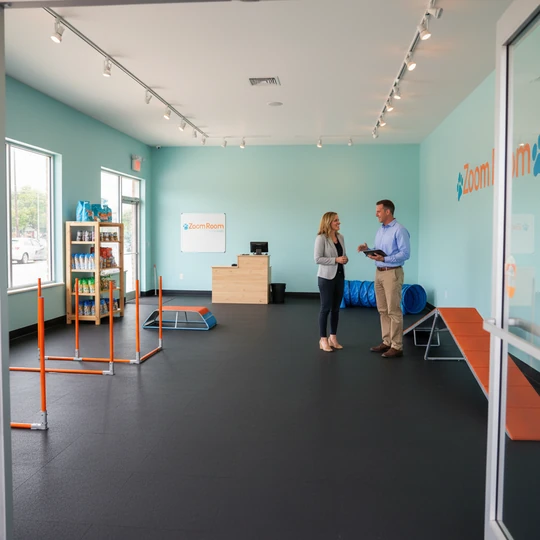
Pet services. The pet industry has grown past $157 billion in the U.S. and continues to expand. Dog training, grooming, daycare, and pet retail franchises sit in the $200K-$500K total range. Zoom Room, the #1 dog training franchise in the Entrepreneur Franchise 500 for 2026, requires $200K in liquid capital — which is above the $150K mark. However, if your net worth supports it and you can bridge the gap through additional savings or a ROBS rollover, it is worth exploring. The total investment of $302,523 to $464,712 is well within SBA lending range.
Fitness concepts. Boutique fitness, yoga, and personal training studios often require $100K-$200K in liquid capital with total investments of $200K-$500K. The membership model creates recurring revenue, but the space has become increasingly competitive.
Children's services. Tutoring, enrichment, swim schools, and kids' activity franchises often land at this investment level. They benefit from parents' willingness to invest in their children's development, creating relatively recession-resistant demand.
Business services. Staffing, consulting, tax preparation, and business coaching franchises sometimes have lower build-out costs since they can operate from modest office space. These work well for people with B2B sales experience.
How to Evaluate Franchises at This Investment Level
With $150K on the line, you need to be rigorous about due diligence. Here is the framework that protects your investment:
Start with the FDD. The Franchise Disclosure Document is your bible. Read Item 7 to understand every dollar of the total investment. Read Item 19 for financial performance data. Read Item 20 for the franchisee contact list. If a franchisor with 20+ locations does not include financial data in Item 19, ask why.
Call franchisees. Validation is the most underused tool in franchise research. Call at least 8-10 current franchisees and 2-3 former ones. Ask about their total investment (was it more than Item 7 suggested?), how long it took to break even, what support they actually receive, and whether they would do it again knowing what they know now.
Build a conservative pro forma. Take the financial data from Item 19 and franchisee conversations, apply local market costs for rent and labor, and build three scenarios: optimistic, realistic, and conservative. If the conservative scenario still shows a viable business within 18-24 months, you have a more durable investment thesis.
Understand ongoing costs. The initial investment is just the beginning. Make sure you account for royalties, marketing fund contributions, technology fees, and any other ongoing fees. These come out of revenue every month and directly affect your margins.
Stretching $150K: Smart Strategies
If $150K is your total liquid capital and you want to make it work in franchising, here are strategies experienced franchise investors use:
ROBS rollover. If you have $50K-$100K+ in a 401(k) or IRA, a ROBS (Rollover for Business Startups) structure lets you use those funds for your franchise without early withdrawal penalties or taxes. This is a legitimate IRS-approved structure, but it needs to be set up properly by a qualified ROBS provider.
SBA lending. As discussed above, SBA loans let you leverage your liquid capital significantly. Getting pre-qualified early in your search helps you understand your true budget and negotiate from a position of strength.
Partner or spouse. If your spouse or a business partner is also contributing capital, your combined liquid position opens up more options. Just make sure the partnership structure is clear and legally documented from the start.
Negotiate the franchise fee. Some franchisors — especially those in growth mode — will negotiate on the franchise fee, offer discounts for veterans, or provide incentives for target markets. It never hurts to ask. The worst they can say is no.
Keep a reserve. Whatever you do, do not invest every dollar into the franchise. Keep 3-6 months of personal living expenses separate from the business. Running out of personal runway while waiting for the business to ramp up is one of the most common reasons franchise owners panic and make bad decisions.
Frequently Asked Questions
- $150K is a solid starting point for many franchise opportunities. It meets or exceeds the liquid capital requirements for hundreds of franchise brands in service, fitness, home services, and children's enrichment categories. With SBA financing, your total investment capacity can reach $400K-$600K or more. The key is pairing your liquid capital with strong credit, relevant skills, and a franchise model that fits your goals.
- Liquid capital is cash and easily converted assets you can access quickly. Net worth is everything you own minus everything you owe — it includes home equity, retirement accounts, vehicles, and other assets that are not easily converted to cash. Most franchisors require minimums for both. For example, a franchise might require $150K liquid and $500K net worth. You need to meet both thresholds, not just one.
- Yes, through a structure called ROBS (Rollover for Business Startups). This lets you roll 401(k) or IRA funds into a new corporation that purchases the franchise, without paying early withdrawal penalties or taxes. It is an IRS-approved structure but must be set up and maintained correctly by a qualified ROBS provider. It is worth exploring if you have significant retirement savings and limited liquid cash.
- SBA lenders typically look for a credit score of 680 or higher, relevant management or industry experience, sufficient equity injection (usually 20-30% of the total project), and a franchise brand with a strong track record. Getting pre-qualified before you choose a franchise tells you exactly what budget you are working with. Many franchise consultants and development teams can connect you with SBA lenders who specialize in franchise financing.
- No. Financial advisors and experienced franchisees consistently advise keeping a personal reserve of 3-6 months of living expenses separate from your franchise investment. The business will take time to ramp up, and you do not want financial desperation driving your business decisions. If investing means going all-in with zero cushion, either wait until you have more savings or explore lower-cost franchise options.
Is $150K enough liquid capital for a franchise? +
What is the difference between liquid capital and net worth for franchises? +
Can I use retirement funds to buy a franchise? +
How do I know if I can get an SBA loan for a franchise? +
Should I invest everything I have in a franchise? +
Explore Franchise Options in the Pet Industry
Zoom Room requires $200K in liquid capital — if you are close to that threshold or can bridge the gap with a ROBS rollover, request information to learn about the investment structure, financial performance, and available territories.
Request InfoThis is not an offer to sell a franchise. An offer can only be made through a Franchise Disclosure Document. Financial performance representations are available in Item 19 of our Franchise Disclosure Document. Contact us to request our FDD.