
What Franchise Can You Start with $300K? More Than You Think.
$300K puts you in the sweet spot of franchise investing. You are past the ultra-low-cost home-based models and into the range where you can build a real brick-and-mortar business with strong brand support. Here is what to know before you write any checks.
The $300K Sweet Spot
$300K as a total investment budget — or even as liquid capital — puts you in a range that franchise consultants call the "sweet spot." You are high enough to access well-developed franchise systems with real infrastructure, training, and brand recognition, but you are not in the territory where you need to be a millionaire to play.
At this level, you are looking at franchises with total investments typically between $250K and $500K. If your $300K is liquid capital and you are open to SBA financing, your effective budget could reach $500K to $700K or more. That opens up even more options.
The key question is not just "what can I afford?" but "what kind of business do I want to run?" A $300K food franchise looks nothing like a $300K service franchise in terms of daily operations, staffing, margins, and lifestyle.
Franchise Categories at the $300K Level
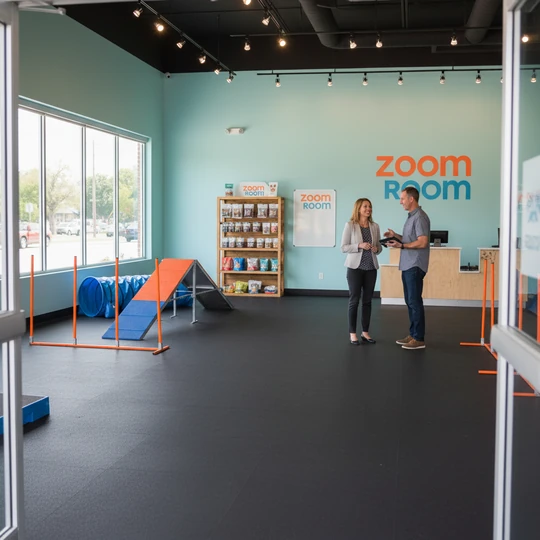
Pet services. The pet industry is booming past $157 billion in the U.S., and franchise concepts in dog training, grooming, daycare, and pet retail sit right in this price range. These businesses benefit from passionate customers who spend consistently on their pets regardless of economic cycles. Zoom Room, ranked #1 in dog training on the Entrepreneur Franchise 500 for 2026, has a total investment range of $302,523 to $464,712 — landing right at this level.
Fitness and wellness. Boutique fitness studios, yoga concepts, and personal training franchises often fall in the $200K-$400K total investment range. The recurring membership model is attractive, but be aware that this space got crowded fast after COVID and competition is intense in many markets.
Home services. Restoration, painting, cleaning, plumbing, and HVAC franchises can range from $100K to $400K. Many operate without a traditional storefront, which keeps overhead down. The trade-off is that you are managing field crews and trucks instead of a single location.
Quick-service food. Some smaller or emerging QSR brands fall in this range, though you should carefully evaluate the economics. Food franchises typically have higher employee counts, food cost management challenges, and thinner margins than service businesses. The ones that work well at this price point tend to have streamlined menus and efficient operations.
Children's services. Tutoring, enrichment programs, kids' fitness, and early education concepts often land in this investment range. These can be rewarding businesses, but keep in mind they are often seasonal and dependent on after-school hours.
What to Look for at This Investment Level
Not all $300K franchises are created equal. Here is what separates the good ones from the money pits:
Proven unit economics. At this price point, you should expect the franchisor to share financial performance data in Item 19 of the FDD. If they will not share any numbers with a system of 20+ locations, ask yourself why. You deserve to see what existing franchisees are experiencing before you commit $300K.
Manageable staffing. Ask how many employees a typical location needs. A franchise that runs with 2-3 people on the floor has drastically different economics than one that needs 10-15. Every additional employee adds payroll, benefits, training time, turnover risk, and management complexity.
Recurring revenue. Businesses where customers come back weekly or monthly — memberships, classes, subscriptions — build more predictable and valuable businesses than those relying on one-time transactions. Look for customer retention metrics in your research.
Reasonable royalty structure. Royalties typically range from 5% to 8% of gross revenue. Make sure you understand the full fee structure including marketing fund contributions, technology fees, and any other ongoing costs. These add up and directly impact your bottom line.
Strong training and support. At $300K, you are paying for more than a brand name. You should get comprehensive initial training, ongoing support, marketing resources, and operational systems that genuinely help you succeed.
How to Evaluate a $300K Franchise Opportunity
Here is the process that experienced franchise investors follow:
Read the full FDD. The Franchise Disclosure Document is 200+ pages of legally required information about the franchise system. Pay close attention to Item 7 (total costs), Item 19 (financial performance), and Item 20 (franchisee list). Most people skip this step or skim it — do not be most people.
Call existing franchisees. This is the single most valuable thing you can do. Validation calls with current and former franchisees will tell you what the business is really like, what support actually looks like in practice, and whether the financial projections are realistic. Aim for 8-10 calls minimum.
Understand the territory. What territory protection does the franchise offer? Is your preferred area available? How does the franchisor determine territory boundaries? You do not want to invest $300K only to have another franchisee open two miles away.
Get your financing lined up. If you plan to use SBA lending, start the conversation with lenders early. Some franchise brands are on the SBA Franchise Registry, which can streamline the approval process. Your franchise consultant or the franchisor's development team can point you in the right direction.
Why the Pet Industry Is Worth Considering at This Budget
If you are exploring franchises at the $300K level, the pet services industry deserves a spot on your short list. Here is why:
Pet spending in the U.S. has grown every single year for the past three decades. That includes through the 2008 financial crisis and the pandemic. People cut back on eating out, vacations, and new clothes before they cut back on their dogs. That kind of recession resilience is rare in any franchise category.
The dog training segment in particular is still relatively unconsolidated. Unlike fast food or fitness, where every corner is saturated, most dog training is still done by independent trainers working alone. A franchise model that professionalizes the experience — with a consistent curriculum, a welcoming facility, and group classes that build community — has a real competitive advantage.
Zoom Room fits this description. With roughly 100 locations and growing, the brand is established enough to have proven systems but young enough that prime territories are still available. The two-person floor model keeps labor costs manageable, and the owner-participatory approach means you are building client relationships directly rather than relying on a revolving door of employees to represent your investment. The 87% customer retention rate reflects a business where people genuinely enjoy coming back.
Frequently Asked Questions
- Yes. If $300K is your total budget including financing, you still have solid options in service-based franchises, home services, and some fitness concepts. Many franchises in the $200K-$300K total investment range require $100K-$150K in liquid capital, with the rest financed through SBA loans. The key is making sure your liquid capital meets the franchisor's requirement and that you have enough runway for working capital.
- Some food franchise concepts fall in this range, particularly smaller quick-service or counter-service models. However, the major national food brands often require $500K to $1M+ for a single unit. At $300K, you may be limited to emerging food brands or non-traditional locations. Before committing, carefully evaluate the labor requirements, food costs, and operating hours — food franchises are typically more operationally demanding than service businesses.
- Focus on three items. Item 7 breaks down every cost you will pay to open. Item 19 shows financial performance data from existing locations — look for revenue ranges, expense breakdowns, and breakeven timelines. Item 20 lists every franchisee with contact information so you can call them directly. A $300K franchise should have strong disclosure and transparency. If the FDD feels thin or evasive, that is a red flag.
- Most franchises take 4 to 9 months from signing the franchise agreement to opening day. This includes site selection, lease negotiation, build-out, training, and pre-opening marketing. Some franchises with simpler models can open faster, while concepts requiring major construction or permits can take longer. Factor this timeline into your financial planning — you will be spending money before any revenue comes in.
Can I start a franchise with $300K total including financing? +
Is $300K enough for a food franchise? +
What should I look for in a franchise FDD at this price point? +
How long does it take to open a franchise after signing? +
Explore a $300K Franchise in the Pet Industry
Zoom Room's total investment starts at $302,523 — right at the $300K mark. Request information to see the full investment breakdown, review Item 19 financial data, and learn about available territories.
Request InfoThis is not an offer to sell a franchise. An offer can only be made through a Franchise Disclosure Document. Financial performance representations are available in Item 19 of our Franchise Disclosure Document. Contact us to request our FDD.