
Dog Daycare vs. Dog Training Franchise: A Head-to-Head Comparison
Both dog daycare and dog training are booming pet categories. But they're fundamentally different businesses under the hood. Before you invest in either, you need to understand how they compare on the things that actually matter to your bottom line and quality of life.
Two Very Different Business Models
Dog daycare and dog training both serve dog owners, but that's where the similarities end. A daycare is a capacity-based business. You fill a facility with dogs during working hours and charge per day or per visit. A training franchise is a program-based business. You run structured classes on a schedule and sell packages or memberships.
That core difference shapes everything else: how much space you need, how many people you hire, what your insurance costs, how customers pay you, and what your daily operations look like. Understanding these differences is the first step toward making a smart investment decision.
Staffing: The Biggest Operating Cost
Staffing is where the two models diverge most dramatically. Dog daycare requires constant supervision. Industry standards and many state regulations require one handler for every 10 to 15 dogs on the floor at all times. If you have 40 dogs in your facility, you need three to four handlers -- all day, every day.
Those handlers are often entry-level employees. Turnover tends to be high because the work is physically demanding, sometimes messy, and wages are typically modest. High turnover means constant recruiting, hiring, and training costs.
A dog training franchise operates on a leaner model. Zoom Room, for example, runs a two-person floor for classes. You need skilled trainers, and they command higher wages -- but you need far fewer of them. A single training location might have two to four trainers compared to eight to twelve daycare attendants at a similar-sized facility.
Lower headcount also means simpler scheduling, less HR complexity, and more manageable payroll. For a first-time business owner, that simplicity is worth a lot.
Liability and Insurance
This is the factor that keeps daycare owners up at night. When you're responsible for other people's dogs without the owner present, incidents happen. Dog fights, bites, injuries, even deaths are documented risks in the daycare industry. Insurance premiums reflect that reality.
Dog training -- especially owner-participatory training -- carries significantly lower liability. When the dog's owner is in the room and actively participating in the class, responsibility is shared. The owner knows their dog, can intervene if needed, and has direct oversight of their pet at all times.
This doesn't mean training businesses have zero liability. Slip-and-fall incidents, a dog getting loose in a parking lot, or a trainer giving bad advice can all create exposure. But the frequency and severity of claims tend to be much lower than in daycare settings.
Lower liability translates directly to lower insurance premiums, which is a meaningful line item when you're building a budget for your first year.
Space Requirements and Build-Out Costs
Dog daycare facilities are expensive to build. You typically need 3,000 to 10,000 square feet or more, with outdoor play areas, industrial-grade flooring that can handle constant use, specialized drainage and plumbing, heavy ventilation systems to manage odor, and separate areas for small and large dogs.
Many daycare facilities are purpose-built or require extensive renovation of industrial or warehouse spaces. Build-out costs of $200,000 to $500,000 or more are common before you add franchise fees and working capital.
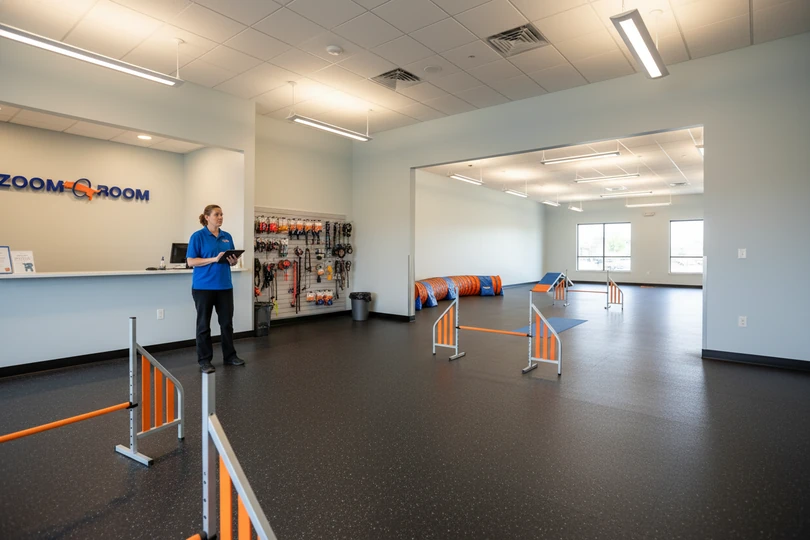
A dog training franchise operates in standard retail or commercial space. Zoom Room locations use open training floors in conventional shopping centers. The build-out is simpler: rubber flooring, mirrors, agility equipment, a retail area, and basic improvements. Total investment for a Zoom Room franchise ranges from $302,000 to $465,000 all-in.
Standard retail space also gives you more site selection options. You can locate near your target customers in suburban shopping centers rather than being limited to industrial zones.
Revenue Model and Customer Retention
Daycare revenue is transactional. A customer drops off their dog and pays for that day. Some facilities sell multi-day packages, but the relationship is still tied to individual visits. If the customer works from home for a week, you lose that revenue.
Training franchises built on memberships and class packages create a different dynamic. A customer might sign up for a puppy socialization series, then continue into basic obedience, then try agility or nose work. Each step deepens the relationship and extends the customer's lifetime value.
Zoom Room reports an 87% customer retention rate. That kind of retention is extremely difficult to achieve in daycare, where customers often shop on price and convenience. In training, the relationship with the trainer and the community keeps customers coming back.
Recurring revenue from memberships and packages also makes financial planning easier. You can forecast next month's revenue with more confidence when a significant portion is already committed through active memberships.
Day-to-Day Operations: What Your Life Actually Looks Like
Running a daycare means your doors open early (often 6:30 or 7:00 AM for drop-offs) and close late (6:00 PM or later for pickups). Some facilities offer boarding, which means overnight staffing. You're managing a facility full of dogs that need to be fed, monitored, separated when conflicts arise, and cleaned up after -- continuously.
The physical plant requires constant maintenance. Flooring takes a beating. Drainage systems need attention. Outdoor areas need to be safe and secure. The smell alone requires serious ventilation investment.
A training franchise runs on a class schedule. Mornings might be quiet while evenings and weekends are busy with classes. You can structure your hours around the schedule. The facility stays cleaner because dogs are in structured classes, not roaming free all day.
Neither model is easy. Both require hustle, especially in the early months. But the operational complexity of daycare is meaningfully higher, and the physical demands on the facility are greater.
Frequently Asked Questions
- Dog daycare franchises typically cost more to open. Between specialized facility requirements, outdoor play areas, industrial flooring, ventilation, and drainage, daycare build-outs often run $500,000 to $1 million or more. Dog training franchises operate in standard retail space with simpler build-outs, typically ranging from $300,000 to $500,000 all-in.
- Dog daycare has significantly higher staffing costs. Industry standards require one handler for every 10-15 dogs on the floor, which means a busy facility needs a large team every day. Dog training franchises operate with smaller teams -- often a two-person floor per class. Fewer employees mean lower payroll, simpler scheduling, and less turnover-related expense.
- Dog training franchises generally see stronger retention because the service creates a progressive relationship. Customers start with basic classes and advance through different programs over months or years. Zoom Room reports 87% retention. Daycare customers tend to be more transactional and price-sensitive, making retention harder to sustain.
- Some businesses do offer both, but combining them adds complexity. You need the facility infrastructure for daycare plus the training curriculum and certified trainers. Insurance requirements expand. Most franchise systems specialize in one or the other to keep the model focused and scalable.
- Dog training franchises tend to be more approachable for first-time owners due to lower capital requirements, simpler operations, smaller teams, and lower liability. Daycare can be lucrative but involves more operational complexity and higher startup costs, which adds risk for someone without business experience.
Which costs more to open: a dog daycare or a dog training franchise? +
Which has higher staffing costs: daycare or training? +
Is customer retention better for dog training or dog daycare? +
Can I run a dog daycare and dog training in the same location? +
Which pet franchise category is better for a first-time business owner? +
See How a Dog Training Franchise Compares
Zoom Room is a dog training franchise built on recurring revenue, owner-participatory classes, and a lean operating model. Explore the opportunity.
Request InfoThis is not an offer to sell a franchise. An offer can only be made through a Franchise Disclosure Document. Financial performance representations are available in Item 19 of our Franchise Disclosure Document. Contact us to request our FDD.