
Best Service Franchise to Own: Why Service Beats Food and Retail
There's a reason experienced franchise investors increasingly gravitate toward service-based concepts. The economics are different -- and in most cases, they're better. Lower overhead, simpler operations, and recurring revenue models create a business that's easier to run and harder to kill.
The Structural Advantages of Service Franchises
Service franchises deliver something. Food and retail franchises sell something. That distinction matters more than it might seem.
When you sell a product, you carry inventory. Inventory ties up capital, creates waste, and requires storage space. When you deliver a service, your primary cost is labor -- and labor can be scheduled to match demand in ways that inventory can't.
Service franchises also tend to have higher gross margins. A restaurant operating on 5% to 10% net margins considers that acceptable. A well-run service franchise can achieve significantly higher margins because there's no food cost, less shrinkage, and lower waste.
The operational complexity gap is equally significant. A food franchise deals with health inspections, food safety compliance, cold chain management, and the perishability of its core product. A service franchise deals with scheduling, quality control, and customer relationships. Both are real work, but one involves far more variables and failure points.
Recurring Revenue: The Service Franchise Advantage
The best service franchises in 2026 are built on recurring revenue models -- memberships, subscriptions, or enrollment-based pricing. This is the single biggest structural advantage over transactional businesses.
With recurring revenue, you start each month knowing a significant portion of your income is already locked in. That predictability transforms everything downstream: you can staff more efficiently, forecast cash flow more accurately, and make growth investments with greater confidence.
Compare that to a restaurant that starts every day at zero. Every customer is a new transaction. Every month requires rebuilding revenue from scratch. The stress difference between these two models is profound, and it shows up in franchisee satisfaction data.
Recurring revenue also increases the resale value of your franchise. Buyers pay premiums for businesses with predictable, repeating income. When it's time to exit, a membership-based service franchise with strong retention will command a higher multiple than a transactional business with equivalent revenue.
Service Franchise Categories Worth Evaluating
Home services remain one of the largest service franchise categories. Restoration, cleaning, painting, HVAC, and plumbing concepts benefit from essential demand and often operate without a storefront. Many home service franchises start under $200K and can scale to multiple territories.
Fitness and wellness franchises have expanded well beyond traditional gyms. Boutique studios focused on yoga, cycling, stretching, and recovery have carved out strong niches. The best ones combine small footprints (1,000 to 3,000 square feet) with membership models that generate high per-square-foot revenue.
Pet care services represent one of the fastest-growing segments of the franchise industry. Within a $157 billion pet industry, services have doubled to $5.9 billion over the past decade. Dog training, in particular, offers a compelling combination: membership-based revenue, strong retention, small footprint, and a product that's driven by emotional necessity rather than impulse.
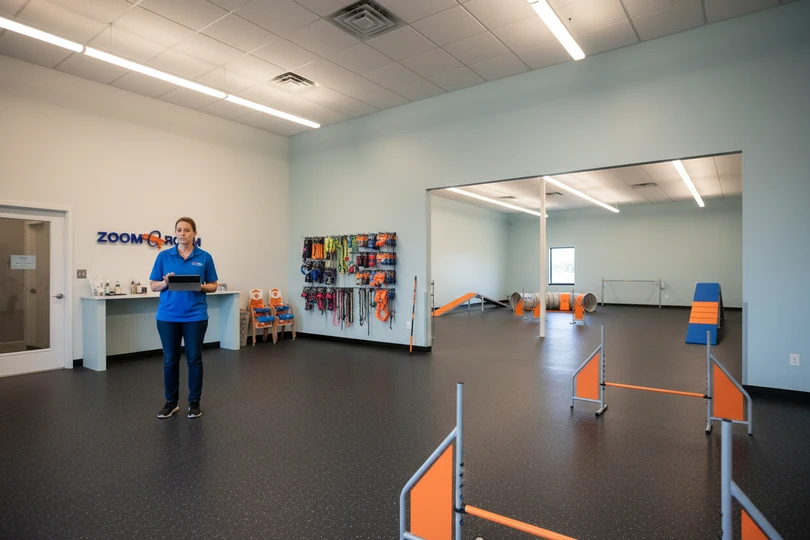
Zoom Room, the #1-ranked dog training franchise, operates on roughly 80% service revenue from its membership-based training programs. The model runs in about 3,000 square feet with two staff per shift -- a labor profile that most food and retail franchises would find enviable.
Education and enrichment franchises (tutoring, STEM programs, music lessons) benefit from subscription-based enrollment and strong emotional demand from parents. They tend to have modest space requirements and favorable peak-hour scheduling.
The Labor Equation: Why Lean Teams Win
Labor is the largest ongoing cost for most franchise businesses, and it's the one that varies most between service and non-service concepts.
A typical quick-service restaurant requires 15 to 30 employees across multiple shifts, with high turnover, complex scheduling, and significant management overhead. A typical service franchise operates with three to eight employees, often with more predictable scheduling and lower turnover.
The financial impact is straightforward: fewer employees means lower payroll, lower workers' compensation costs, fewer HR issues, and less time spent hiring and training. It also means that each employee matters more, which can actually improve culture. Small teams tend to be more cohesive than large ones.
Zoom Room's two-staff-per-shift model is a good example of this principle in action. With a small, well-trained team, the business can deliver high-quality service without the management burden of a large workforce. That simplicity translates to better margins and a more manageable owner experience.
How to Evaluate a Service Franchise
If you're convinced that a service franchise is the right path, here's how to narrow your search.
Start with the revenue model. Prioritize concepts with recurring revenue over those dependent on one-time transactions. Ask how much revenue comes from memberships or subscriptions versus walk-in or project-based work.
Review the Item 19 carefully. How transparent is the franchisor about unit-level financial performance? Systems that disclose detailed financial data tend to have more confidence in their numbers -- and that confidence is usually earned.
Look at the total cost of ownership, not just the initial investment. What are the ongoing royalties, marketing fund contributions, technology fees, and occupancy costs? Royalty structures vary significantly between service franchise systems.
Talk to franchisees. During validation calls, ask about revenue ramp-up, working capital needs, and how long it took to reach their break-even point. The answers will tell you more than any marketing material.
Finally, assess the competitive landscape. Is the market crowded, or does the franchise occupy a differentiated position? The strongest service franchises solve a specific problem in a way that's hard to replicate independently. Zoom Room's socialization-first approach to dog training is an example -- most people don't want a trained dog, they want a socialized dog, and that positioning creates a distinct value proposition.
Frequently Asked Questions
- Service franchises generally offer higher margins, simpler operations, lower labor requirements, and less regulatory complexity than food franchises. They also avoid the challenges of food cost management, perishable inventory, and the intense competition in the restaurant space. Service franchises with recurring revenue models add the benefit of predictable monthly income.
- Service franchises with membership-based revenue models, small footprints, and low labor requirements tend to have the strongest margins. Pet care services, boutique fitness, and specialized home services are among the higher-margin service franchise categories. The key driver is the ratio of revenue to fixed costs, particularly labor and occupancy.
- Service franchise investments range from under $50K for home-based concepts to $500K or more for facility-based models. The sweet spot for most first-time owners is $150K to $400K, which typically includes a dedicated physical location, equipment, training, and working capital. Zoom Room's total investment ranges from $302,523 to $464,712.
- Some service franchises are designed for semi-absentee ownership, where you hire a manager and oversee the business part-time. Others require full-time owner involvement, especially in the first year. The best approach is to ask the franchisor directly and then verify with current franchisees during validation calls.
Why are service franchises better than food franchises? +
What service franchises have the best margins? +
How much does a service franchise cost? +
Can I run a service franchise semi-absentee? +
A Service Franchise Built on Recurring Revenue
Zoom Room generates roughly 80% of revenue from membership-based training programs. Two staff per shift. 3,000 square feet. Ranked #1 in dog training.
Request InfoThis is not an offer to sell a franchise. An offer can only be made through a Franchise Disclosure Document. Financial performance representations are available in Item 19 of our Franchise Disclosure Document. Contact us to request our FDD.