
Franchise Opportunities Under $500K: Where Your Investment Goes Furthest
Half a million dollars is a meaningful line in franchising. Below it, you avoid the complexity and risk of restaurant buildouts and large facility concepts. Above it, you're competing with well-capitalized multi-unit operators. Here's what the under-$500K landscape looks like in 2026.
Why $500K Is the Sweet Spot for First-Time Franchise Buyers
The franchise universe roughly splits into three tiers. Under $100K, you're looking at mobile businesses, home-based services, and very lean operations. Over $500K, you're in restaurant territory, large fitness studios, or multi-unit plays. The $100K to $500K range sits in the middle, and it's where many of the most compelling opportunities live.
At this investment level, you can afford a dedicated physical location -- a real business with a storefront, signage, and a team. But you're not taking on the extreme buildout costs, large labor forces, and thin margins that characterize the higher-investment categories.
This range also tends to align with SBA lending limits and the financial profiles of career-changers coming from corporate roles with $200K to $300K in liquid capital. If that describes you, you're in good company.
Service Franchises: The Largest Category Under $500K
Service-based franchises dominate the under-$500K space, and for good reason. They typically have lower buildout costs, simpler operations, and stronger margins than product-based businesses.
Home services (cleaning, restoration, handyman, landscaping) often fall in the $75K to $250K range. Many are home-based or van-based, which eliminates lease costs entirely. The trade-off is that revenue potential per unit is generally lower than facility-based concepts.
Fitness and wellness studios range from $150K to $500K depending on size and equipment requirements. Concepts with smaller footprints and minimal equipment (yoga, stretching, recovery) sit at the lower end. Full gym buildouts push toward the top of the range.
Education and tutoring franchises typically invest $100K to $350K. These benefit from strong recurring revenue through enrollment-based models and relatively low labor requirements.
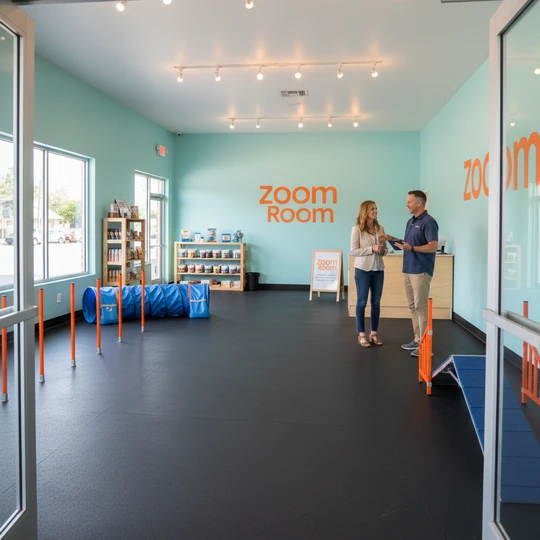
Pet care services span the full range. In-home dog training franchises can start under $100K. Facility-based concepts like dog training franchises with dedicated indoor spaces typically fall in the $200K to $500K range. Zoom Room, for instance, has a total investment of $302,523 to $464,712 for a roughly 3,000-square-foot indoor training facility.
Food Franchises Under $500K: They Exist, But Read the Fine Print
A few food franchise concepts fit under the $500K threshold, but they tend to be smaller-format operations -- food trucks, kiosks, counter-service-only locations, or delivery-focused models. Traditional sit-down restaurants almost never fit in this range.
If you're considering a food franchise under $500K, pay close attention to a few things. First, margins. Food costs eat 28% to 35% of revenue, and labor adds another 25% to 35%. That leaves a much thinner margin than most service businesses. Second, working capital. Food businesses often have longer ramp-up periods, meaning you need more cash reserves to cover losses before the business stabilizes.
For many buyers, the calculus is straightforward: the non-food franchise alternatives at the same investment level offer simpler operations, better margins, and less day-to-day stress. That doesn't mean food franchises are bad -- it means they demand more from you operationally and financially.
How to Compare Franchise Investments at the Same Price Point
Two franchises that both cost $400K can look completely different once you dig into the numbers. The total investment is just the starting point. Here's what else to compare.
Revenue model. Does the franchise generate revenue through one-time transactions or recurring memberships? Recurring revenue creates more predictable cash flow, which matters enormously for loan repayment and long-term planning.
Labor requirements. A business that needs two employees per shift has a fundamentally different cost structure than one that needs eight. Labor is typically the largest ongoing expense, and it's also the hardest to manage.
Breakeven timeline. How long until the business is cash-flow positive? This determines how much working capital you need and how long your personal finances are under pressure. Review Item 19 of the FDD for any available financial performance data.
Complexity. Some businesses are operationally simple -- a clean service model with a focused menu of offerings. Others require managing inventory, equipment maintenance, regulatory compliance, and complex scheduling. Simpler usually means easier to scale and easier to sell.
Where Dog Training Fits in the Under-$500K Landscape
Dog training franchises occupy an interesting position in the under-$500K space. They combine the recurring revenue benefits of a membership model with the emotional resonance of the pet industry -- a $157 billion market that has grown for more than 25 consecutive years.
Within dog training, the investment spectrum is wide. In-home training franchises like Dog Training Elite start at $50K to $80K but come with the limitations of a service-area model: weather dependence, travel time between appointments, and limited scalability.
Facility-based training franchises offer a different value proposition. Zoom Room's total investment of $302,523 to $464,712 gets you an indoor training facility in a standard retail-zoned space with roughly 3,000 square feet. The model runs with two staff per shift and generates approximately 80% of revenue from training services, with the balance coming from retail.
The socialization-first approach sets certain training franchises apart. Most people don't want a trained dog -- they want a socialized dog. A dog that's comfortable around other dogs, calm in public, and enjoyable to live with. That insight drives higher enrollment, stronger retention (Zoom Room reports 87% customer retention), and more referrals than a traditional obedience-focused model.
Compared to daycare and boarding concepts like Dogtopia ($532K to $1.1M) or Camp Bow Wow ($566K to $1.1M), a training-focused franchise requires significantly less investment while still operating in the high-growth pet services space.
Making Your Decision: What Matters More Than Price
The investment amount gets your attention, but it shouldn't be the deciding factor. A $200K franchise with weak unit economics is a worse deal than a $450K franchise with strong unit economics and a faster path to profitability.
Focus on the ratio of investment to potential return, not the absolute number. Read the FDD carefully. Talk to franchisees. Understand the framework for evaluating franchise ROI. And make sure the concept fits your skills, lifestyle, and long-term goals -- not just your budget.
The best franchise under $500K is the one where the model works, the support is real, and the industry is growing. Price is just the starting line.
Frequently Asked Questions
- The best franchise under $500K depends on your goals, skills, and market. Service-based franchises in pet care, fitness, and home services consistently offer strong unit economics at this investment level. Look for concepts with recurring revenue models, low labor requirements, and proven franchisee satisfaction rather than just the lowest price.
- Yes. SBA 7(a) loans are the most common financing vehicle for franchises in this range. Most lenders require 10% to 20% equity injection, relevant business experience or transferable skills, and good personal credit. ROBS (Rollover for Business Startups) is another option if you have retirement funds available.
- Higher-investment franchises typically include a dedicated physical location with a full buildout, more established brand infrastructure, and potentially higher revenue potential. Lower-investment franchises may be home-based, mobile, or operate in smaller spaces. The key is not the investment amount itself but the ratio of investment to expected returns and the quality of the operating model.
- Most franchises in the $300K to $500K range require $150K to $250K in liquid capital. This covers the equity injection for financing, working capital during the ramp-up period, and a personal financial cushion. Zoom Room, for example, requires $200K in liquid capital and $750K in net worth.
What is the best franchise to buy for under $500K? +
Can I get financing for a franchise under $500K? +
What's the difference between a $200K franchise and a $400K franchise? +
How much should I have in liquid capital for a franchise under $500K? +
A Proven Model Under $500K
Zoom Room's total investment starts at $302,523 for the #1 dog training franchise in America. Membership-based revenue, two staff per shift, 3,000 square feet.
Request InfoThis is not an offer to sell a franchise. An offer can only be made through a Franchise Disclosure Document. Financial performance representations are available in Item 19 of our Franchise Disclosure Document. Contact us to request our FDD.