
You Have $500K for a Franchise. Here's How to Make It Count.
With $500K in available capital, you are playing in the upper tier of franchise investing. The question is not what you can afford — you can afford most things. The question is how to deploy that capital for the strongest return. Let's dig in.
What $500K Opens Up That Lower Budgets Cannot
At $500K — whether that is liquid capital or total investment budget — you have access to franchise opportunities that people with $150K or $200K simply cannot reach. But more importantly, you have strategic flexibility.
With $500K liquid and SBA financing, your total investment capacity can exceed $1M. That puts you in range for premium single-unit concepts, multi-unit agreements, and even area development deals where you commit to opening multiple locations over time.
The advantage of this position is optionality. You can choose to invest in one premium franchise and keep capital in reserve for expansion. You can start with a proven concept and open a second location once the first is profitable. Or you can negotiate a multi-unit deal upfront and lock in your preferred territories before someone else does.
The danger at this level is overthinking. People with $500K sometimes spend two years researching and never pull the trigger. Analysis paralysis is real, and the best franchise territories do not wait around.
Premium Single-Unit Franchises
At the $500K level, your single-unit options are extensive. Here are the categories worth exploring:
Full-service restaurant concepts. Sit-down restaurant franchises often require $400K-$1M+ in total investment. The margins can be strong if you execute well, but the operational complexity is high — large staff, food cost management, long hours, and intense local competition. This is the highest-risk, highest-effort franchise category.
Premium fitness and wellness. High-end fitness studios, med spas, and wellness centers often fall in the $300K-$700K range. The membership model creates recurring revenue, and the "wellness economy" trend shows no signs of slowing down.
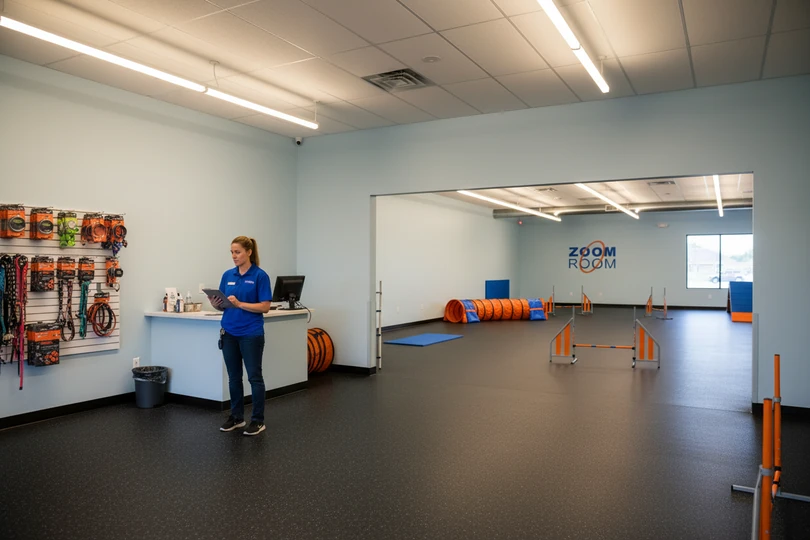
Pet services. With pet industry spending past $157 billion and growing, pet franchises represent a sweet spot of manageable operations and strong demand. Zoom Room, ranked #1 in dog training on the Entrepreneur Franchise 500 for 2026, has a total investment range of $302,523 to $464,712. With $500K available, you could open a single Zoom Room location and keep significant reserves for working capital, marketing, or a second location down the road.
Education and childcare. Preschools, learning centers, and tutoring franchises can run $300K-$800K. These benefit from essential demand — parents need childcare — but face regulatory complexity and staffing challenges.
Automotive services. Quick lube, tire, and automotive repair franchises can range from $200K-$500K+. They benefit from a large addressable market and repeat customers, but require specialized knowledge or hiring certified technicians.
Multi-Unit Strategy: The Real Power Move
With $500K, the most interesting play might not be a single expensive unit. It might be a multi-unit strategy with a more moderately priced concept.
Here is the math. If a franchise has a total investment of $300K-$465K per unit and you have $500K in liquid capital plus access to SBA financing, you could open your first location, prove the model, and then scale to 2-3+ locations within a few years. Multi-unit franchisees often negotiate better terms — reduced franchise fees on subsequent units, shared marketing costs, and operational efficiencies from running multiple locations.
The key to multi-unit success is choosing a brand with a business model simple enough to replicate. If the first location requires you to be physically present 50 hours a week, scaling to three locations is unrealistic. Look for systems with strong operating playbooks, technology-enabled management, and lean staffing models that work well under a general manager once you have proven the concept as an owner-operator.
Zoom Room's model is interesting in this context. The two-person floor model and structured class schedule create a repeatable operation. Franchise owners who master the first location have a clear path to opening additional territories — the pet industry demand is strong enough across most markets to support multiple locations within a metro area.
Area Development Agreements
If you are thinking big, an area development agreement (ADA) lets you lock in the right to develop multiple locations within a defined territory over a set timeline (typically 3-5 years).
The benefits of an ADA include territory protection (nobody else can open in your area), potentially discounted franchise fees on subsequent units, and the ability to plan your expansion strategically rather than scrambling for territories later.
The risks include commitment — you are obligating yourself to open a set number of locations on a schedule. If the first unit underperforms or you run into personal issues, you still owe the development schedule. Most ADAs have penalties for missed milestones, which could include losing your rights to undeveloped territories.
For someone with $500K, an ADA for 2-3 locations in a growing franchise system can be a powerful wealth-building strategy. You get first-mover advantage in your market, build operational expertise across units, and create a business that has real scale and resale value. Multi-unit franchise resales command premium multiples because buyers are acquiring a portfolio of cash-flowing businesses, not just a single job.
What to Watch Out for at This Investment Level
Having more money does not make you immune to bad franchise investments. In fact, it can make you a bigger target for aggressive franchise sales teams. Here is what to watch for:
Do not overpay for a brand name. Some franchise systems charge premium fees simply because of brand recognition, but the unit economics for franchisees are mediocre. Always look at what franchisees actually earn relative to what they invest — not just how famous the brand is.
Beware of "emerging" concepts with no track record. With $500K, you will be pitched on exciting new brands that are "the next big thing." Some of them are. Most are not. If a franchise has fewer than 20 open locations, the track record is too thin to draw conclusions. Stick with systems that have enough data to evaluate in Item 19 and enough franchisees to call during validation.
Do not skip the boring work. At every investment level, the FDD is your protection. At $500K, the stakes are higher and the FDD matters even more. Read every page. Call every franchisee you can reach. Hire a franchise attorney to review the agreement. The $3K-$5K you spend on legal review could save you from a $500K mistake.
Plan your capital deployment. You do not have to invest all $500K on day one. Consider investing $300K-$400K in the first unit, keeping reserves for working capital, and then deploying the remaining capital toward a second unit once the first is performing. Patient capital deployment is almost always smarter than going all-in immediately.
Frequently Asked Questions
- For most first-time franchise investors, starting with one unit and doing it well is the smarter play. Splitting focus across two brands or two locations from day one doubles the complexity and risk. Open your first unit, prove you can operate it profitably, build systems and hire a strong team, and then expand. The exception is if you have significant management experience and a partner who can run the second location.
- There is no single answer because returns depend on the brand, your market, your execution, and economic conditions. Service-based franchises with recurring revenue, lean staffing, and strong customer retention tend to deliver favorable unit economics relative to investment. Look at Item 19 financial data in the FDD and talk to existing franchisees about their actual returns rather than relying on sales presentations.
- Both paths have merit. A franchise resale gives you day-one revenue, an existing customer base, and a proven location — but you pay a premium for that. A new unit lets you build from scratch, choose your location, and shape the culture — but you face the ramp-up period with no revenue. With $500K, you could potentially do either. Resales are listed in Item 20 of the FDD and through franchise resale brokers.
- An area development agreement gives you the exclusive right to open a set number of locations within a defined territory over a specific timeline. You typically pay a development fee upfront that covers the franchise fees for all committed units. The benefit is territory protection and often discounted fees. The risk is that you are contractually obligated to meet the development schedule or potentially lose your territorial rights.
Should I invest $500K in one franchise or split it across two? +
What franchise gives the best return on a $500K investment? +
Is it better to buy an existing franchise location or start a new one? +
How do area development agreements work for multi-unit franchises? +
Explore Multi-Unit Opportunities with Zoom Room
With roughly 100 locations and prime territories still available, Zoom Room offers multi-unit franchise opportunities in the pet industry. Request information to learn about area development, investment structure, and financial performance.
Request InfoThis is not an offer to sell a franchise. An offer can only be made through a Franchise Disclosure Document. Financial performance representations are available in Item 19 of our Franchise Disclosure Document. Contact us to request our FDD.