
Zoom Room vs. Dog Training Elite: A Side-by-Side Franchise Comparison
Prospective franchisees comparing dog training franchise opportunities will likely evaluate both Zoom Room and Dog Training Elite. Both operate in the growing pet services category, but they represent meaningfully different business models, training philosophies, and investment profiles. This comparison aims to present the key differences fairly and factually.
Business Model Comparison
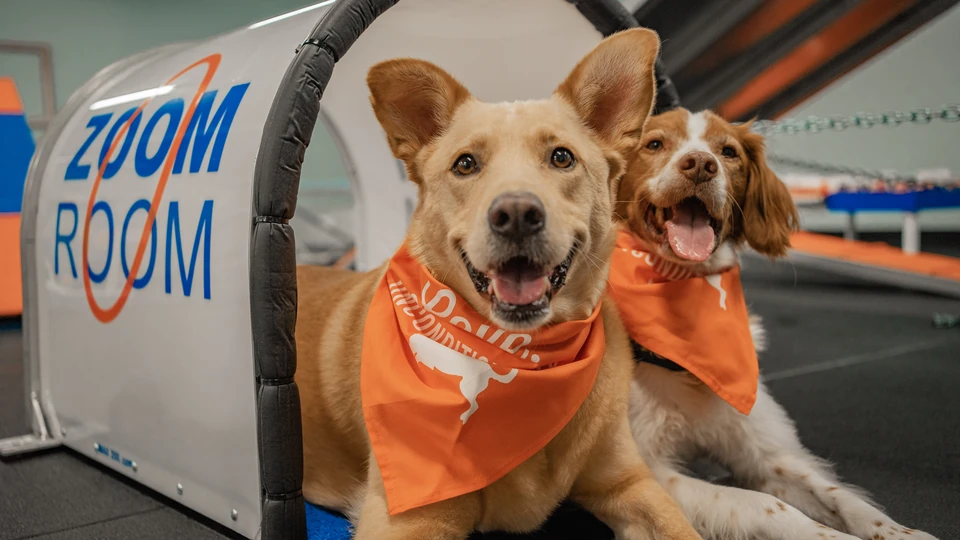
Zoom Room operates a facility-based model centered on group training classes in a dedicated approximately 3,000 square foot location. Classes include puppy socialization, obedience, agility, enrichment, and specialty programs. The model is owner-participatory, meaning pet parents attend and train alongside their dogs in every class. Revenue comes from class packages, memberships, and retail. The model requires two staff per shift.
Dog Training Elite operates primarily through in-home and in-facility private training delivered by contracted trainers. The model is trainer-centric rather than facility-centric, with a significant portion of services delivered at the client's location. Some Dog Training Elite locations also offer board-and-train programs. The model relies on a network of trainers rather than a single dedicated facility.
The structural difference is significant. Zoom Room's facility-based group model creates a community hub where dog owners interact, build relationships, and become long-term members. Dog Training Elite's in-home model provides convenience and individual attention but has different community dynamics. Each model has advantages depending on market characteristics and operator preferences.
Training Methodology
Zoom Room uses exclusively positive reinforcement methods. No shock collars, prong collars, dominance-based techniques, or aversive methods are permitted in any Zoom Room facility. This commitment to science-based, reward-only training is a foundational brand principle, not a preference -- it is a non-negotiable standard that applies to every class and every instructor in the system.
Dog Training Elite uses a balanced training approach, which typically incorporates both positive reinforcement and correction-based techniques. Balanced training may include the use of tools like e-collars (electronic collars) alongside reward-based methods. This approach has its advocates and can be effective for certain training goals, though it is increasingly out of step with the direction of mainstream veterinary behavioral science.
The methodological difference is fundamental and reflects different philosophies about the human-animal relationship. Prospective franchisees should consider both their personal values and their target market's preferences. The positive reinforcement movement is the dominant trend in professional dog training, supported by the American Veterinary Society of Animal Behavior, the Association of Professional Dog Trainers, and peer-reviewed research. However, balanced training retains market share in some regions and demographics.
From a business perspective, methodology affects brand positioning, customer demographics, referral relationships (veterinarians increasingly refer only to positive reinforcement trainers), and liability exposure (aversive tools carry higher injury and behavioral fallout risk).
Investment and Financial Comparison
Zoom Room's total investment ranges from $302,000 to $465,000, including a $49,500 franchise fee. The investment covers the buildout of a dedicated facility, equipment, technology, pre-opening marketing, and working capital. Financial requirements include $200,000 in liquid capital and $750,000 in net worth. Veterans receive a 10% franchise fee discount.
Dog Training Elite's total investment is generally lower, reflecting the less facility-dependent model. Their investment typically ranges from approximately $119,000 to $280,000 with a franchise fee of $49,800. Lower buildout costs result from the in-home service model that requires less dedicated space. Financial requirements are generally lower as well.
Lower investment does not automatically mean better value. The relevant comparison is return on investment, which depends on revenue potential, margins, customer lifetime value, and the sustainability of the business model. A facility-based model with group classes, high retention, and a community dynamic may generate different economics than an in-home model built on private sessions delivered by contracted trainers.
Prospective franchisees should compare both systems' FDDs (particularly Item 7 and Item 19), speak with franchisees from both systems, and model their specific market economics rather than comparing headline investment numbers in isolation.
Scalability and Growth
Zoom Room has approximately 57 locations with a growth target of 550 by 2030. The franchise is ranked #1 in Dog Training on the Entrepreneur Franchise 500 for 2026 and is an Inc. 5000 Top 40 franchise. The leadership team includes former executives from Petco, Disney, Microsoft, and Orangetheory Fitness.
Dog Training Elite has grown to over 100 locations since launching its franchise program. The company has demonstrated rapid unit growth, facilitated in part by the lower investment threshold and the flexibility of the in-home service model, which can launch faster than a facility buildout.
Growth metrics should be evaluated in context. Rapid unit growth can reflect strong demand and efficient franchise sales, but it can also create challenges if growth outpaces the franchisor's ability to provide quality support, training, and infrastructure. The quality of growth -- measured by franchisee satisfaction, unit-level economics, and system stability -- matters more than the pace of growth.
Multi-unit scalability differs between the models. Zoom Room's facility-based model scales through additional locations, each requiring buildout and staffing. Dog Training Elite's model can potentially scale within a territory by adding trainers without proportional facility investment. Both approaches have trade-offs in terms of quality control, brand consistency, and operational complexity.
Leadership and Support
Zoom Room's leadership includes Mark Van Wye (CEO, #1 bestselling author, ex-Disney/Microsoft), Ron Coughlin (Chairman, former Petco CEO), Soumik Chatterjee (CFO, former Petco CSO), Don Allen (COO, 30+ years fitness operations), Jackie Mendes (SVP FranDev, 25+ years franchise experience), and Herb Heiserman (CGO, former CAVA CMO). The team combines deep pet industry knowledge with franchise scaling expertise from nationally recognized brands.
Dog Training Elite was founded by Cameron Summerhays, who built the business from a local dog training operation in Utah. The company's leadership brings dog training expertise and franchise development experience, though the executive team's background differs in profile from Zoom Room's corporate pedigree.
Leadership quality is subjective but consequential. A leadership team with experience scaling national consumer brands, executing IPOs, and building multi-hundred-unit franchise systems brings different strategic capabilities than a team with primarily dog training and regional business backgrounds. Both can succeed, but the risk profiles and strategic depth differ.
Support infrastructure should be evaluated through franchisee conversations, not marketing materials. Ask existing franchisees from both systems about the quality and responsiveness of training, technology, marketing support, and ongoing operational guidance.
How to Make the Comparison Yourself
This comparison provides a framework, but the decision should be based on first-hand research. Request the FDD from both Zoom Room and Dog Training Elite. Compare Item 7 (investment), Item 19 (financial performance, if disclosed), and Item 20 (franchisee list and system statistics).
Speak with franchisees from both systems. Ask identical questions to both groups: How long to breakeven? Are you profitable? How is corporate support? Would you invest again? What surprised you? What do you wish you had known? Direct comparison of first-person franchisee experiences is more valuable than any marketing comparison.
Visit operating locations of both franchises if possible. Experience the customer journey from the inside. Observe facility quality, class delivery, staff engagement, and customer interactions. The in-person experience reveals differences that documents and phone calls cannot capture.
Consider personal fit honestly. Zoom Room's group-class, facility-based model appeals to operators who want to build a community hub and be present in a physical location. Dog Training Elite's in-home model may appeal to operators who prefer a more flexible, less facility-dependent structure. Neither model is inherently better -- the right choice depends on your goals, preferences, and market.
Evaluate training methodology carefully. If you are committed to exclusively positive reinforcement methods, Zoom Room is the aligned choice. If you are comfortable with balanced training approaches, Dog Training Elite may also be a fit. Consider also how your local veterinary community, potential referral partners, and target customer base view different training methodologies -- these stakeholder perspectives directly affect your business development.
Frequently Asked Questions
- The primary differences are business model and training methodology. Zoom Room operates facility-based group classes using exclusively positive reinforcement methods, with an owner-participatory model where pet parents attend every class. Dog Training Elite operates primarily through in-home private training using balanced methods that may include both positive reinforcement and correction-based techniques. These differences affect investment requirements, customer experience, scalability, and brand positioning.
- Zoom Room has a higher total investment ($302,000-$465,000) compared to Dog Training Elite (approximately $119,000-$280,000). The difference primarily reflects Zoom Room's dedicated facility buildout. However, investment cost alone is not a complete comparison -- return on investment depends on revenue potential, margins, retention, and long-term unit economics. Both systems' FDDs should be reviewed for complete financial analysis.
- Dog Training Elite has more total locations (100+) compared to Zoom Room (approximately 57). However, growth pace should be evaluated in context of growth quality, franchisee satisfaction, and unit-level economics. Zoom Room holds the #1 Dog Training ranking on the Entrepreneur Franchise 500 and is targeting 550 locations by 2030. Both brands are actively expanding, and territory availability varies by market.
- Neither franchise requires prior dog training experience. Both provide training on their respective methodologies. Zoom Room's comprehensive curriculum covers positive reinforcement techniques and business operations. Dog Training Elite provides training on its balanced approach. The key qualifications for both are business management skills, community engagement, and alignment with the brand's training philosophy.
What is the main difference between Zoom Room and Dog Training Elite? +
Which franchise costs more to open? +
Which franchise is growing faster? +
Do I need dog training experience for either franchise? +
Explore the Zoom Room Franchise Opportunity
Request the Zoom Room Franchise Disclosure Document to review detailed investment, performance, and support information. Start the due diligence process with a conversation.
Request InfoThis is not an offer to sell a franchise. An offer can only be made through a Franchise Disclosure Document. Financial performance representations are available in Item 19 of our Franchise Disclosure Document. Contact us to request our FDD.