Second Career Franchise Opportunities: Building the Next Chapter
A franchise can be the ideal second act. You bring decades of professional experience, financial stability, community roots, and the clarity that comes from knowing what you want out of work. Whether you are retiring from a corporate career, transitioning from the military, or simply ready for something different, franchising offers a structured path to ownership that leverages everything you have already built.
Why Franchising Works as a Second Career
Second-career franchise buyers have structural advantages that younger, first-time business owners typically lack.
Financial readiness. Decades of earning, saving, and investing mean that second-career buyers often meet franchise financial requirements comfortably. The liquid capital minimums and net worth thresholds that screen out under-capitalized buyers -- Zoom Room requires $200,000 in liquid capital and $750,000 net worth -- are more accessible to someone with 20 to 30 years of wealth accumulation behind them.
Professional experience. The management, financial, and leadership skills developed over a career translate directly to franchise operations. You are not learning these capabilities for the first time -- you are applying them in a new context. This accelerates the learning curve and reduces the risk of operational mistakes.
Emotional clarity. Second-career buyers know what they value. They have experienced corporate politics, economic cycles, and career transitions. They approach franchise evaluation with a maturity and realism that produces better decisions. The question is no longer "can I succeed in business" but "which business aligns with how I want to spend the next decade."
Community integration. If you are buying a franchise in the community where you already live, you bring existing relationships, local knowledge, and social credibility. These assets accelerate customer acquisition and community engagement in ways that a newcomer cannot replicate.
Semi-Absentee Ownership: Flexibility by Design
Many second-career franchise buyers are not looking for a 60-hour-a-week grind. They want a business that generates income and builds equity without consuming every waking hour. Semi-absentee franchise models are designed for exactly this scenario.
In a semi-absentee model, a trained general manager handles daily operations while the owner focuses on financial oversight, strategic decisions, team development, and community engagement. The owner is involved -- typically 15 to 25 hours per week once the business is stabilized -- but not on the floor for every shift.
Not every franchise system supports semi-absentee ownership effectively. The models that do share several characteristics:
Robust operating systems. The franchise must have documented procedures, technology platforms, and training programs comprehensive enough that a general manager can execute the operation at brand standards without the owner present.
Clear KPIs and reporting. The owner needs real-time visibility into financial performance, customer metrics, and operational health. Dashboard-based reporting and regular financial statements are essential for managing from a strategic altitude.
Manageable team size. Smaller teams are easier to manage remotely. Zoom Room's model, with approximately two staff members per shift, represents a lean operating structure that a semi-absentee owner can oversee effectively through a strong general manager.
Recurring revenue. Membership and subscription-based models provide predictable revenue that reduces the day-to-day sales pressure. When the customer base renews automatically, the business generates consistent income without requiring aggressive daily sales activity.
Financial Considerations for Second-Career Buyers
Second-career franchise buyers face unique financial planning considerations that deserve careful attention.
Retirement fund usage. ROBS (Rollover for Business Startups) allows you to use 401(k) or IRA funds to invest in a franchise without early withdrawal penalties or taxes. This is particularly relevant for second-career buyers who have accumulated significant retirement savings. The strategy requires careful structuring -- work with a ROBS specialist -- but it is a legitimate, IRS-approved mechanism that can fund the equity injection without depleting liquid savings.
Risk tolerance shifts. At 50 or 60, your risk tolerance is different from what it was at 30. You have less time to recover from a significant financial loss, and your retirement timeline is closer. This reality argues for conservative financial planning: overcapitalize the business, maintain reserves beyond the investment, and avoid putting all your financial eggs in one basket.
Income timeline. If you need immediate income replacement, the 12- to 24-month ramp-up period of a new franchise may create a gap. Plan for this gap with savings, a spouse's income, pension income, or other sources. If the gap is financially stressful, consider a franchise resale -- purchasing an existing location with established revenue -- rather than starting from scratch.
Tax planning. Franchise ownership creates opportunities for tax optimization that salaried employment does not: depreciation, business expense deductions, entity structuring, and retirement plan contributions through the business. Work with an accountant who understands both franchise taxation and retirement planning to maximize these benefits.
Estate and succession planning. If you are building a franchise as a legacy asset, your estate plan should address how the business will be handled. Franchise agreements have specific provisions about succession and transfer that need to align with your estate planning goals.
Choosing the Right Category for Your Second Career
The right franchise category for a second career depends on your goals, your energy level, your financial position, and what you want your daily experience to look like.
If you want community impact: Education, pet services, fitness, and wellness franchises offer the satisfaction of making a visible difference in people's lives. The pet industry, in particular, combines community engagement with a strong emotional connection -- pet guardians are deeply invested in their animals' wellbeing, creating authentic relationships between the business and its customers.
If you want scalability: Service-based franchises with clear multi-unit development paths allow you to start with one location and grow into a portfolio. This approach works well for former executives who want to build an organization rather than operate a single business.
If you want minimal physical demands: Professional services, consulting, and home-based franchises offer business ownership without the physical requirements of retail or food service operations. These models often have lower total investments and more flexible operating structures.
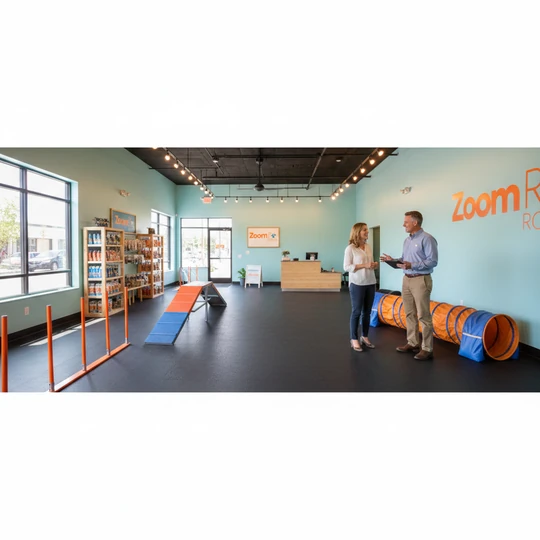
If you want a balance of involvement and freedom: Service franchises with semi-absentee potential offer the best of both worlds. You are building and overseeing a business -- maintaining intellectual engagement -- without the demands of full-time, on-site operation. Zoom Room's model balances this effectively: the approximately 3,000-square-foot facility and two-person shift structure creates a manageable operation that can be overseen strategically once the initial ramp-up is complete.
Legacy Building: The Long View
For second-career buyers, a franchise is often more than a business. It is a vehicle for building something that outlasts your direct involvement -- a legacy asset that generates value for your family or serves as a platform for community contribution.
The franchise structure supports legacy building in several ways. The brand, the system, and the corporate support infrastructure provide continuity that independent businesses lack. If you build a successful franchise operation, it has transferable value because the buyer is acquiring a known brand and proven system, not just the goodwill you personally created.
Succession planning within the franchise context has specific considerations. Franchise agreements may allow family transfers, but the receiving party must meet the franchisor's qualifications. Planning for this eventuality -- potentially involving family members in the business early -- ensures a smoother transition when the time comes.
The financial legacy is equally important. A franchise that generates strong cash flow and appreciates in value over ten to fifteen years can represent a significant portion of your estate. The combination of income during your operating years and sale proceeds at exit creates a total return that contributes meaningfully to family wealth.
Franchising also creates a platform for community legacy. A well-run local business becomes a fixture in its community -- a gathering place, an employer, a sponsor of local events, and a contributor to the neighborhood's character. For second-career buyers who value community roots, this dimension of franchise ownership can be as rewarding as the financial returns.
Frequently Asked Questions
- There is no upper age limit for franchise ownership, and many franchise systems actively seek experienced buyers with strong financial profiles and professional backgrounds. Buyers in their 50s and 60s represent a significant and growing segment of franchise purchasers. The key considerations are financial planning (risk tolerance, income timeline, retirement integration) and choosing a model that matches your desired level of physical involvement and time commitment.
- Yes, through a ROBS (Rollover for Business Startups) strategy that allows you to use 401(k) or IRA funds without early withdrawal penalties or taxes. This requires establishing a C-corporation, creating a new qualified retirement plan, and rolling existing funds into it. The process is legal and IRS-approved but requires specialized administrators. ROBS is particularly common among second-career franchise buyers.
- The best franchise for a retiree depends on desired involvement level, financial goals, and personal interests. Semi-absentee models in service categories -- pet care, fitness, professional services -- offer the flexibility to stay engaged without full-time operational demands. Evaluate the operating model, staffing requirements, and semi-absentee suitability of any franchise before assuming it matches a retirement lifestyle.
- Work with a financial advisor who understands both franchise investment and retirement planning. Key principles: do not invest more than you can afford to lose, maintain retirement reserves outside the business, use ROBS strategically to preserve liquid savings, and choose a franchise with realistic exit potential so the business can be converted back to retirement assets through a future sale.
- Yes, but it requires the right franchise model, a strong general manager, and disciplined oversight. Semi-absentee does not mean uninvolved -- expect 15 to 25 hours per week of strategic management once the business is stabilized. The first year typically requires more hands-on involvement. Verify that the franchisor explicitly supports semi-absentee ownership and that existing semi-absentee franchisees confirm the model works in practice.
Am I too old to buy a franchise? +
Can I use my retirement savings to buy a franchise? +
What is the best franchise for a retiree? +
How do I balance franchise investment with retirement planning? +
Is semi-absentee franchise ownership realistic? +
Explore a Franchise for Your Next Chapter
Zoom Room offers a service-based model in the growing pet industry with lean operations, strong retention, and a manageable path to ownership.
Request InfoThis is not an offer to sell a franchise. An offer can only be made through a Franchise Disclosure Document. Financial performance representations are available in Item 19 of our Franchise Disclosure Document. Contact us to request our FDD.