
Home-Based vs. Brick-and-Mortar Franchise: When Each Model Works and When It Doesn't
The choice between a home-based franchise and a brick-and-mortar franchise is often framed as a simple cost decision: one is cheap, the other is expensive. But cost is only one variable in a more complex equation that includes credibility, growth potential, customer experience, resale value, and long-term wealth creation. The right model depends on your goals, your market, and how you define success.
The Real Cost Difference
Home-based franchises typically require $50,000 to $150,000 in total investment. This covers the franchise fee ($15,000 to $50,000), equipment or technology ($5,000 to $30,000), initial marketing ($5,000 to $15,000), a vehicle or wrap if mobile ($10,000 to $40,000), and working capital. There's no lease, no buildout, no signage, and no commercial utilities. Your home office is your headquarters.
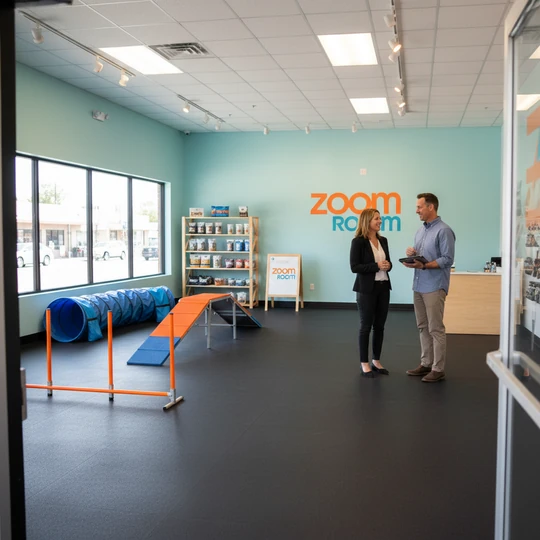
Brick-and-mortar franchises range from $150,000 to over $1 million depending on the concept. The additional cost covers leasehold improvements ($30,000 to $200,000), commercial rent deposits ($5,000 to $20,000), signage and exterior branding ($5,000 to $25,000), furniture and fixtures ($10,000 to $50,000), and higher initial marketing budgets to drive foot traffic. Zoom Room, for example, requires $302,000 to $465,000 for approximately 3,000 square feet of purpose-built space.
But the cost comparison is incomplete without the revenue side. A home-based franchise typically generates $100,000 to $400,000 in annual revenue. A well-positioned brick-and-mortar franchise often generates $400,000 to $1.5 million. The larger investment buys a larger revenue engine. The relevant metric is return on investment, not absolute cost.
Credibility and Brand Perception
This is where the comparison gets uncomfortable for home-based franchise advocates. Customers, partners, and lenders perceive businesses with physical locations differently than those operated from a spare bedroom. A brick-and-mortar location communicates permanence, professionalism, and investment. A home-based business, regardless of the quality of service, starts with a credibility gap that must be overcome.
The credibility difference is quantifiable in certain markets. B2B clients making purchasing decisions often require vendor site visits. Insurance companies adjusting claims prefer working with restoration companies that have visible, inspectable facilities. Parents enrolling children in tutoring want to see the learning environment. Pet parents choosing a training program want to observe the space, the equipment, and the atmosphere before committing their dog and their money.
Home-based franchises mitigate this through mobile service delivery (bringing the service to the customer's location), strong online presence and reviews, and the value proposition of convenience. These strategies work, particularly for services where the customer's location is the natural point of delivery (home cleaning, lawn care, mobile grooming). But for services where the customer comes to you, a physical location is not just branding; it's a functional requirement.
Growth Ceiling: The Scalability Question
Home-based franchises face inherent scalability constraints. Growth typically means adding more service providers (technicians, cleaners, consultants) who operate independently in the field. Each additional provider adds management complexity: scheduling, quality control, vehicle logistics, and the constant risk that a key employee leaves and takes their customer relationships with them.
Brick-and-mortar franchises scale differently. The location itself is an asset that generates revenue independently of any single person. Customers come to the brand and the facility, not to the individual owner. This means the business can be staffed with employees, managed by a general manager, and eventually operated semi-absentee or sold as a going concern.
The growth path for ambitious franchisees also differs. A home-based franchise owner who wants to grow typically adds territories or starts a second brand. A brick-and-mortar franchisee typically opens additional locations of the same brand, building a portfolio that creates operational efficiencies and increasing brand strength in the market. Multi-unit brick-and-mortar operations are a well-understood path to significant wealth in franchising.
Customer Experience and Retention
The customer experience in a home-based franchise is defined by the service provider and the service itself. A mobile dog groomer delivers quality grooming in a well-equipped van. A home cleaning team delivers a clean house. The experience is functional and efficient, but it lacks the environmental cues, the sensory experience, and the community dimension that a physical location provides.
A brick-and-mortar franchise creates an experience that extends beyond the core service. A dog training facility like Zoom Room offers not just instruction but a social environment where pet parents meet, share experiences, and form a community around a shared interest. A fitness studio creates a sense of belonging that goes beyond the workout. These experiential elements drive customer retention and word-of-mouth referrals in ways that purely functional service delivery cannot match.
The retention data reflects this. Membership-based and class-based brick-and-mortar franchises often achieve customer retention rates of 60 to 80 percent on an annual basis. Home-based service franchises typically see higher customer churn because the switching costs are lower; hiring a different mobile groomer or cleaning service requires no more effort than making a phone call.
Resale Value and Exit Strategy
The resale market for brick-and-mortar franchises is significantly more developed than for home-based operations. A training facility with an established location, a customer base, trained staff, and a remaining lease term is a tangible asset that buyers can evaluate and finance. Typical resale multiples for profitable brick-and-mortar franchises range from 2x to 4x annual cash flow.
Home-based franchises are harder to sell because much of the business value is tied to the owner's personal relationships and reputation. A buyer is essentially purchasing the right to use the brand, the equipment, and the customer list, but without the guarantee that customers will transfer their loyalty to a new operator. Resale multiples for home-based franchises are typically lower, often 1x to 2x annual cash flow, and the buyer pool is smaller.
If building long-term wealth through business equity is part of your investment thesis, the brick-and-mortar model has a structural advantage. The business you build can be sold as an independent asset. The premium you pay in initial investment often returns when you exit.
When Each Model Makes Sense
Choose home-based when: Your budget is under $150,000 and financing is not available or desired. You want to test entrepreneurship with lower financial risk. The service you're providing is naturally delivered at the customer's location. You don't plan to build a large-scale business or employ many people. You want maximum schedule flexibility and minimal fixed overhead.
Choose brick-and-mortar when: You're investing for long-term wealth creation and eventual resale. The service benefits from a dedicated physical environment (training, fitness, education, wellness). You want to build a business that can eventually run without your daily involvement. You're planning multi-unit expansion. You want the credibility and marketing advantage of a visible community presence.
The hybrid path: Some franchise owners start home-based to learn the industry and build capital, then transition to a brick-and-mortar concept once they understand the market and have the resources for a larger investment. This staged approach reduces early risk while preserving the option for larger-scale growth.
Frequently Asked Questions
- A home-based franchise can be a good investment for people seeking lower-risk entry into business ownership, those with limited capital, or those providing services naturally delivered at customer locations. The trade-offs include lower revenue potential, limited scalability, and lower resale value. For people who want to test entrepreneurship without a large financial commitment, home-based franchises serve as a valuable entry point.
- This depends on the franchise system. Some brands are exclusively home-based or exclusively location-based. Others offer models that allow owners to evolve from home-based to storefront as the business grows. If conversion is part of your long-term plan, choose a franchise system that explicitly supports this transition and has existing franchisees who have made the shift successfully.
- Yes, many home-based franchise owners generate $75,000 to $200,000 in annual income, particularly in home services, consulting, and mobile services. The income ceiling is typically lower than brick-and-mortar franchises, but the lower overhead means a higher percentage of revenue converts to take-home pay. Profitability depends on the concept, the market, and the owner's effort level.
- The best investment depends on your budget, market, and interests. In the pet industry, Zoom Room is ranked number one in dog training by Entrepreneur for 2026, operating in approximately 3,000 square feet with a total investment of $302,000 to $465,000. In fitness, education, and wellness, numerous concepts offer strong returns in the $200,000 to $500,000 range. Evaluate Item 19 data, franchisee satisfaction, and market fit rather than seeking a single universal recommendation.
Is a home-based franchise a good investment? +
Can I convert a home-based franchise to a brick-and-mortar location? +
Do home-based franchises make money? +
What is the best brick-and-mortar franchise to invest in? +
A Brick-and-Mortar Franchise Built for Efficiency
Zoom Room combines the advantages of a physical location, brand presence, and community experience, with a compact 3,000-square-foot model and lean staffing. Ranked number one in dog training by Entrepreneur in 2026.
Request InfoThis is not an offer to sell a franchise. An offer can only be made through a Franchise Disclosure Document. Financial performance representations are available in Item 19 of our Franchise Disclosure Document. Contact us to request our FDD.