
Can You Run a Franchise While Keeping Your Day Job? The Real Answer.
This is one of the most popular questions on franchise subreddits — and the answers are all over the map. Some people say it is totally doable. Others call it a fantasy. The truth depends entirely on which franchise model you pick and how realistic you are about time.
The Semi-Absentee Dream vs. Reality
Let's start with the term you will hear constantly: "semi-absentee franchise." This describes a franchise model where you hire a manager to handle day-to-day operations while you oversee the business with 10-15 hours per week of involvement.
On paper, it sounds perfect. Keep your salary, build a business on the side, eventually transition when the franchise income replaces your paycheck. In practice, it works for some franchise models and falls apart completely in others.
The franchise models that work in a semi-absentee structure tend to share certain traits: simple operations that can be systematized, limited employee count, technology-enabled management, and a business model where the customer experience does not depend on the owner being present at all times.
The ones that fail in semi-absentee mode are typically businesses where the owner's personal involvement drives sales, where employee management is complex, or where the operating hours are long and unpredictable.
Which Franchise Types Actually Work Part-Time
Based on what franchise owners actually report — not what franchise salespeople promise — here are the models that tend to work with reduced owner involvement:
Home service franchises. Cleaning, painting, junk removal, and similar businesses can sometimes be managed remotely if you have a strong crew lead. You handle scheduling, customer calls, and marketing while your team does the fieldwork. The challenge is quality control — you need to trust your team to represent your investment.
Vending and self-service models. Laundromats, ATM networks, and vending franchises are inherently designed for low involvement. The trade-off is usually lower revenue potential and less growth upside.
Some fitness and wellness concepts. If the business relies on group classes led by certified instructors, you can manage the business side without teaching every class yourself. This works better once you have a reliable team in place.
What does NOT typically work semi-absentee: restaurants (the complexity is too high), retail with significant inventory management, and any model where the owner is the primary salesperson or relationship builder.
Why Most Franchisors Prefer Full-Time Owners
Here is something the semi-absentee marketing glosses over: most franchise systems are designed for full-time owner-operators, and they perform better with involved owners.
Why? Because nobody cares about your business as much as you do. A hired manager shows up and does a job. An owner shows up and builds a future. The difference shows up in customer experience, cost management, team culture, and ultimately revenue. Franchise systems with higher owner involvement tend to report higher franchisee satisfaction and better Item 19 results.
This does not mean semi-absentee is impossible. It means you should go in with eyes open. If you are keeping your day job, you are essentially asking someone else to care about your $300K+ investment as much as you do. That is a big ask, and finding the right manager is often harder than people expect.
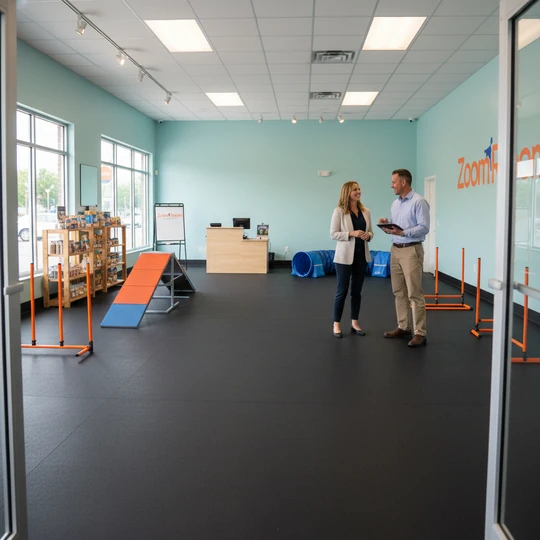
Some franchise models — like Zoom Room's owner-participatory approach — are specifically designed so that the owner is involved in the business. The two-person floor model means you and one team member run the facility. This is not a semi-absentee play, but it is efficient — you are not managing a staff of 15, and the operating hours are structured and predictable. For many people, this is actually a better answer than semi-absentee: a business you can run yourself without it consuming your entire life.
The Realistic Timeline If You Want to Transition
If your goal is to eventually leave your day job for franchise ownership, here is a more realistic approach than trying to do both simultaneously from day one:
Months 1-6: Research phase. Keep your job. Use evenings and weekends to research franchise options, attend discovery days, review FDDs, and talk to existing franchisees. This phase costs nothing but time and is essential for making a good decision.
Months 6-9: Preparation phase. Secure financing, sign the franchise agreement, and begin site selection. You can still be employed during this phase. Most franchisors work around your schedule for initial steps.
Months 9-12: Training and build-out. This is where it gets harder to maintain your day job. Most franchise training programs require 1-3 weeks of full-time attendance. Build-out and pre-opening preparation also need significant attention. Some people use PTO or negotiate flexible schedules during this period.
Month 12+: Launch. The first 3-6 months of operations are the most critical. If at all possible, be fully present during this phase. This is when you set the tone for your business, build customer relationships, train your team, and establish operating rhythms. Trying to do this with half your attention is a recipe for a slow start.
Questions to Ask Yourself Before Going Part-Time
Before committing to a franchise you plan to run alongside a day job, be honest about these questions:
Does your employer allow it? Many employment contracts have non-compete or moonlighting clauses. Check before you invest $300K in a side project that could cost you your salary.
Can you really commit 15-20 hours per week? That is evenings, weekends, and probably some calls during your lunch break. For months or years. If you are already stretched thin, adding franchise management on top may lead to burnout and underperformance in both roles.
Can you afford a manager from day one? If the franchise needs someone present during business hours and you will be at your day job, you need a full-time manager. That is $40K-$60K+ in annual payroll before the business may be generating enough revenue to cover it. Run the numbers.
What does the franchisor require? Some franchisors contractually require the owner to be the primary operator, especially during the first year. Ask about this during your discovery process — you do not want to sign a franchise agreement and then find out you are in violation by not being present.
Is the franchise designed for this? Talk to existing franchisees and ask if any of them run the business semi-absentee. How is their performance compared to full-time owners? The franchisees will give you a straight answer — they have nothing to lose by being honest.
Frequently Asked Questions
- Truly low-time franchises tend to be in vending, self-service laundry, ATM networks, or similar asset-based models. These can run on 5-10 hours per week but typically have lower revenue ceilings. Service franchises and brick-and-mortar concepts generally require more involvement, especially in the first 1-2 years. Be skeptical of any high-revenue franchise claiming it needs minimal owner time — that usually means you are paying a manager to do what you should be doing.
- You can, but it comes with trade-offs. A full-time manager adds $40K-$60K+ in payroll costs, which cuts into your margins during the ramp-up phase when every dollar matters. Manager-run locations also tend to underperform owner-operated ones because the incentive structure is different. If you go this route, invest heavily in finding the right person and build in performance incentives that align their interests with yours.
- During the first year, most franchise owners work 40-60 hours per week in the business. After the first year, as systems mature and the team gets stronger, many owners settle into 30-45 hours. Some models with lean staffing and predictable schedules can get even lower. The initial investment of time is front-loaded — expect to work harder in year one than in year three.
- It varies by brand. Some franchise systems actively market semi-absentee ownership as an option. Others require full-time owner involvement, especially in the first year. This is outlined in the franchise agreement and should be discussed during your initial conversations with the development team. Do not assume you can run it part-time just because the investment fits — ask specifically about ownership requirements.
- Underperformance creates a dangerous cycle. Low revenue means less money to invest in improvements, which leads to further underperformance. The franchisor may also intervene — most franchise agreements include performance standards, and consistently poor results can trigger default provisions. If you cannot commit the time needed to build the business properly, it may be smarter to wait until you can give it full attention rather than risk your investment.
What franchise requires the least amount of time from the owner? +
Can I hire a manager to run my franchise while I keep my job? +
How many hours per week does a franchise owner typically work? +
Will a franchise system let me be a part-time owner? +
What happens if my franchise underperforms because I am not there enough? +
Ready to Explore Full-Time Franchise Ownership?
Zoom Room's owner-participatory model is built for hands-on owners who want to be part of the business. Request information to learn about the day-to-day, the economics, and what the ownership lifestyle actually looks like.
Request InfoThis is not an offer to sell a franchise. An offer can only be made through a Franchise Disclosure Document. Financial performance representations are available in Item 19 of our Franchise Disclosure Document. Contact us to request our FDD.