
Best Franchises Under $500K: Full-Service Concepts With Multi-Unit Potential
The $300,000 to $500,000 franchise investment range represents the upper tier of single-unit franchise ownership. At this level, you are buying into established brands with proven systems, significant support infrastructure, and business models designed for scale. This is where franchise ownership begins to look more like building a company and less like buying a job.
The Economics of a $500K Franchise Investment
Franchises in this investment range typically target annual revenue of $600,000 to $1.5 million per location. The higher capital outlay funds larger spaces (2,000 to 5,000 square feet), more sophisticated buildouts, better equipment, and larger opening marketing budgets. The result is a business that can generate meaningful revenue from day one rather than building slowly over months.
At this level, multi-unit expansion becomes a realistic part of the conversation from the outset. Many franchise systems at the $300K to $500K level offer area development agreements where you commit to opening two, three, or five locations over a defined timeline in exchange for reduced franchise fees and protected territory. If your long-term goal is building a portfolio of franchise locations, starting at this investment level often makes more sense than trying to scale up from a $100K concept.
The financing picture is also different. SBA 7(a) loans regularly fund franchise investments at this level, and many franchisees combine SBA financing with personal savings, ROBS rollovers, or home equity. Lenders are generally comfortable with established franchise brands in this range because the failure rates are typically lower than for startup businesses or unproven franchise concepts.
Pet Services: Training, Daycare, and Hybrid Models
The pet franchise landscape spans a wide investment range, but the $300K to $500K bracket is where some of the most interesting concepts operate. Dog training, pet wellness, and smaller-format hybrid models fit here, while the largest daycare facilities push into the $500K to $1 million-plus territory.
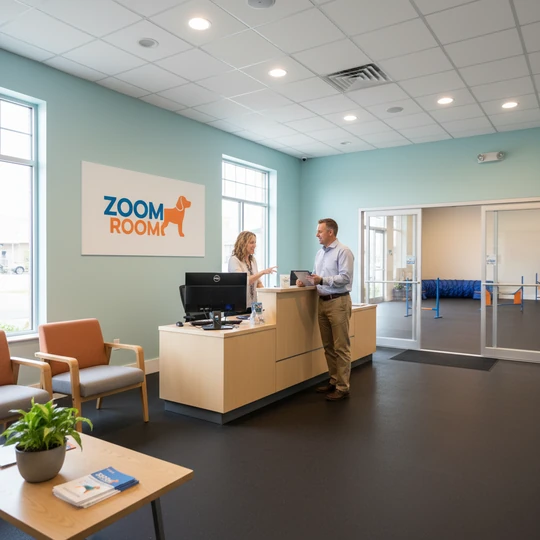
Zoom Room exemplifies the efficient end of this range. With a total investment of $302,000 to $465,000, a franchise fee of $49,500, and a compact approximately 3,000-square-foot footprint, the model is designed for capital efficiency. The class-based revenue structure means the space generates revenue from multiple clients simultaneously, producing higher revenue per square foot than one-on-one service models. Ranked number one in dog training on Entrepreneur's Franchise 500 for 2026, the brand has established clear category leadership.
At the upper end of this range, pet daycare and boarding concepts begin to enter the picture, though most of the major daycare brands (Dogtopia, Camp Bow Wow) have total investments that start in the $500K range and extend well past $1 million. If you are evaluating daycare concepts near the $500K mark, scrutinize whether the quoted investment range is realistic or represents a best-case scenario that excludes common overruns in construction and equipment.
Health, Fitness, and Medical Services
Full-service fitness studios, physical therapy clinics, medical aesthetics practices, and urgent care franchises operate in this investment range. These businesses combine professional-grade facilities with recurring revenue models and often benefit from insurance reimbursement or employer wellness programs as additional revenue streams.
Physical therapy and rehabilitation franchises are particularly interesting because they operate in a market with strong demographic tailwinds. An aging population needs more physical therapy, and the shift from hospital-based rehab to outpatient clinics has created opportunities for franchise operators. Total investments typically run $250,000 to $450,000, and revenue per clinic can reach $800,000 to $1.5 million at maturity.
Medical aesthetics franchises (Botox, fillers, body contouring, laser treatments) have grown rapidly but require careful evaluation. Some operate under a medical director model where the franchisee manages the business while licensed practitioners perform treatments. Verify that the franchise's compliance model meets your state's medical practice regulations, as these vary significantly.
Food Concepts Worth Considering
While this guide isn't focused on food franchises, the $300K to $500K range does include food concepts worth mentioning for comparison. Fast-casual restaurants, specialty coffee shops, and limited-menu concepts operate here, and many franchise buyers are deciding between food and non-food options at this budget level.
The trade-offs are well-documented. Food franchises can generate high top-line revenue ($700K to $1.5M is common for fast-casual) but typically operate on net margins of 5 to 12 percent. Labor costs are high, food waste is constant, health inspections add regulatory burden, and hours of operation often extend to 12 or more per day, seven days per week.
By contrast, service-based franchises at the same investment level may generate lower top-line revenue but often achieve higher net margins (15 to 25 percent is achievable in pet services, fitness, and professional services) with simpler operations, fewer employees, and more predictable scheduling. The question is not just how much the business makes, but how much of that revenue reaches your pocket after expenses.
Multi-Unit Strategy: Planning Beyond Your First Location
At the $300K to $500K level, the multi-unit question becomes central to your franchise evaluation. Many buyers at this level plan to own three to five locations within five years. That changes what you should look for in a franchise system.
Scalability indicators include: a proven model for semi-absentee management (can the business run without the owner present daily?), a general manager compensation structure that attracts and retains talent, systems for multi-location oversight (dashboards, KPIs, centralized scheduling), and a track record of successful multi-unit franchisees within the system.
Ask the franchisor specifically about their multi-unit operators. What percentage of franchisees own more than one location? How long does it typically take to open a second unit? What does the economics look like for a three-unit operator versus a single-unit operator? The answers reveal whether the franchise system is genuinely designed for growth or whether multi-unit ownership is a theoretical possibility that few franchisees actually achieve.
Due Diligence at the $500K Level
The stakes are higher at this investment level, and your due diligence should be correspondingly thorough. Beyond the standard FDD review and franchisee validation calls, consider these additional steps.
Hire a franchise attorney. Not a general business attorney, but one who specializes in franchise law. They will review the Franchise Agreement, identify unfavorable terms, and potentially negotiate modifications. At this investment level, the $3,000 to $5,000 legal fee is a negligible cost for significant risk reduction.
Build a detailed financial model. Use Item 19 data, franchisee input, and your local market research to build a month-by-month financial projection for years one through three. Account for seasonality, ramp-up period, and a realistic timeline to manager-run operations if that's your goal.
Visit operating locations. Spend a full day at two or three franchisee locations in markets similar to yours. Observe the customer flow, talk to staff, and watch the operation in action. What you learn from observation often exceeds what you learn from documents and phone calls.
Verify the territory. At this investment level, territory rights are a significant portion of what you're buying. Map the territory boundaries precisely, understand what protections exist against encroachment, and confirm how many additional franchises the franchisor plans to sell in your market area.
Frequently Asked Questions
- The strongest franchise investments under $500K are found in pet services, premium fitness and wellness, professional services (staffing, consulting), and medical services. At this level, look for concepts with proven multi-unit operators, strong Item 19 financial data, and business models that can eventually run with a general manager rather than requiring daily owner involvement.
- With $500K in total capital, you can typically open one location and have reserves for a second unit 18 to 24 months later, especially if you use SBA financing for 70 to 80 percent of each location. Many franchisees at this level negotiate area development agreements that lock in reduced franchise fees for future units in exchange for a development commitment.
- ROI varies significantly by market, operator, and concept. Service-based franchises with recurring revenue, lean staffing, and compact spaces tend to produce the best returns relative to investment. Study Item 19 data across multiple brands, focusing not just on average revenue but on median performance and the distribution between top and bottom quartile operators. The best ROI comes from matching the right concept to the right market and the right operator.
- Not inherently, but the profile is different. A $500K franchise typically offers higher absolute revenue, a more transferable business asset, greater brand recognition, and more comprehensive support. A $100K franchise offers lower financial risk, faster break-even, and simpler operations. The right choice depends on your financial capacity, risk tolerance, and whether you want to build a scalable business or generate independent income with lower overhead.
What are the best franchise investments under $500K? +
Can I own multiple franchise locations with $500K? +
What franchise has the best ROI under $500K? +
Is a $500K franchise better than a $100K franchise? +
Explore the Number One Dog Training Franchise
Zoom Room fits within the sub-$500K range with a total investment of $302,000 to $465,000. Ranked number one in dog training by Entrepreneur for 2026, the model offers a compact footprint, lean staffing, and a class-based revenue model built for efficiency.
Request InfoThis is not an offer to sell a franchise. An offer can only be made through a Franchise Disclosure Document. Financial performance representations are available in Item 19 of our Franchise Disclosure Document. Contact us to request our FDD.