
Best Franchises Under $200K: The Sweet Spot for First-Time Franchise Buyers
The $100,000 to $200,000 investment range opens a significantly broader landscape of franchise opportunities. This is where home-based models give way to brick-and-mortar options, service businesses gain physical credibility, and categories like fitness, education, and specialty services become accessible. For many first-time buyers, this budget represents the intersection of manageable risk and meaningful opportunity.
Why $200K Is Considered the Franchise Sweet Spot
At this investment level, something important shifts: you gain access to businesses with a physical presence. A storefront, a studio, a center. That changes the equation in meaningful ways. Customers trust a brand they can walk into. Lenders are more comfortable financing a business with a tangible location. And when it comes time to sell, a franchise with a lease, equipment, and established foot traffic is worth more than a home-based operation dependent on the owner's personal relationships.
The $100K to $200K range also tends to be where franchise systems invest most heavily in franchisee support. These aren't bare-bones license agreements. Brands at this level typically provide extensive initial training (often two to four weeks), dedicated launch support, marketing systems, and ongoing coaching. The franchise fee, usually $30,000 to $50,000, funds real infrastructure.
Boutique Fitness and Wellness Studios
Boutique fitness franchises are among the most popular concepts in this range. Yoga studios, barre classes, cycling studios, and functional training concepts often land between $120,000 and $200,000 total investment. The membership model creates predictable monthly revenue, and the classes-based format means you're selling time slots rather than physical products.
The strongest fitness franchise models achieve 60 to 70 percent gross margins on class revenue. The key metric to evaluate is member retention: how many members stay beyond six months, beyond a year. High-churn fitness brands require constant marketing spend to replace departing members, which destroys profitability.
The market saturation question is real. In major metros, you might find five boutique fitness studios within a three-mile radius. Do your demographic homework. Suburban markets with growing populations and limited boutique options often present better opportunities than oversaturated urban areas.
Education and Enrichment Programs
Tutoring centers, STEM programs, coding academies, and children's enrichment franchises frequently operate in the $80,000 to $175,000 range. These businesses benefit from a powerful demand driver: parents will prioritize their children's education even when cutting back on other spending.
The unit economics of education franchises are worth understanding. Revenue is primarily driven by enrollment count and price per session or semester. A tutoring center with 100 active students paying $200 per month generates $20,000 in monthly revenue from a relatively small physical space, often 1,200 to 2,000 square feet. Margins depend heavily on instructor costs, which typically represent 35 to 45 percent of revenue.
Seasonality matters. Summer enrollment drops for academic tutoring, and many education franchises offset this with camps, enrichment programs, or test prep intensives. Ask franchisors about their twelve-month revenue distribution, not just peak-season numbers.
Home Services at Scale
While basic home services franchises operate under $100K, the $100K to $200K range gives you access to higher-end concepts: restoration and remediation, painting, HVAC maintenance, and specialized cleaning services. These businesses typically command higher per-job pricing and serve both residential and commercial clients.
A restoration franchise, for example, might invest $150,000 to $200,000 in specialized equipment (dehumidifiers, air movers, moisture detection tools) but charge $3,000 to $15,000 per job rather than the $150 to $300 per visit of a basic cleaning service. The revenue potential per job is dramatically higher, though the work is project-based rather than recurring.
Commercial contracts can transform the economics of a home services franchise. A single contract with a property management company or insurance carrier can represent $10,000 to $50,000 in monthly revenue. If a franchise system has established relationships with national insurance companies or property managers, that's a significant competitive advantage.
Specialty Retail and Personal Services
At the upper end of this range, you start seeing specialty retail and personal services concepts: pet grooming salons, beauty and spa services, senior care coordination, and specialty food shops (not full restaurants). These businesses occupy small retail spaces of 800 to 2,000 square feet and serve a defined local customer base.
What distinguishes these from home-based models is the walk-in factor. A visible storefront generates organic awareness every day. People driving past your location see the brand, remember it, and eventually become customers. This passive marketing effect is something home-based businesses never benefit from.
The trade-off is lease commitment. A five to ten year commercial lease is a significant obligation, and lease costs vary dramatically by market. The same franchise concept might cost $2,500 per month in a secondary market and $8,000 per month in a major metro. Run the numbers for your specific market before projecting profitability from system-wide averages.
Evaluating Franchises in This Range: A Practical Checklist
FDD Item 19 analysis. At this investment level, any credible franchise should include financial performance representations in their Franchise Disclosure Document. If Item 19 is blank, ask why. Transparency about unit economics is a baseline expectation for a $200K investment.
Franchisee validation calls. Speak with at least eight to ten existing franchisees, including some who have been in the system for less than two years and some who have been operating for five or more years. Ask about actual revenue, actual expenses, support quality, and whether they'd make the same decision again.
Break-even timeline. Understand how long it takes the average franchisee to reach monthly break-even. In this investment range, 12 to 18 months is typical. If the franchisor claims break-even in three months, be skeptical.
Total fee burden. Calculate the all-in annual cost of the franchise relationship: royalties (typically 5 to 8 percent), marketing fund (1 to 3 percent), technology fees ($200 to $500 per month), and any required vendor purchases. Some franchise systems take 12 to 15 percent of gross revenue in combined fees, which significantly impacts your bottom line.
Frequently Asked Questions
- With $200K, you can access boutique fitness studios, education and tutoring centers, specialty home services, pet grooming or wellness concepts, and small-format retail franchises. This range covers businesses with a physical location, established brand presence, and comprehensive franchisee support. The specific options depend on your market, interests, and whether you're using financing to extend your purchasing power.
- For many franchise categories, $200K is more than sufficient. However, ensure this figure covers the full investment range listed in the franchise's Item 7 (the cost breakdown in the FDD), plus three to six months of personal living expenses and business working capital. Being undercapitalized is one of the most common reasons franchises struggle in their first year, regardless of the concept's quality.
- First-time owners should prioritize franchises with extensive training programs, strong ongoing support, and a proven operational system that doesn't require industry expertise. Service-based franchises and education concepts are often good fits because the franchisor provides the methodology, and you focus on management and customer relationships. Avoid concepts where success depends heavily on specialized technical skills you don't possess.
- Starting with one franchise is almost always the better approach. Running a franchise requires your full attention during the first 12 to 24 months, and splitting focus between two locations typically means both underperform. Build one successful unit first, then use that experience and cash flow to fund expansion. Multi-unit ownership is a growth strategy, not a launch strategy.
What franchise can I buy with $200K? +
Is $200K enough to open a franchise? +
What is the best franchise for a first-time business owner? +
Should I buy one franchise at $200K or two at $100K each? +
A Franchise Worth Evaluating at This Level
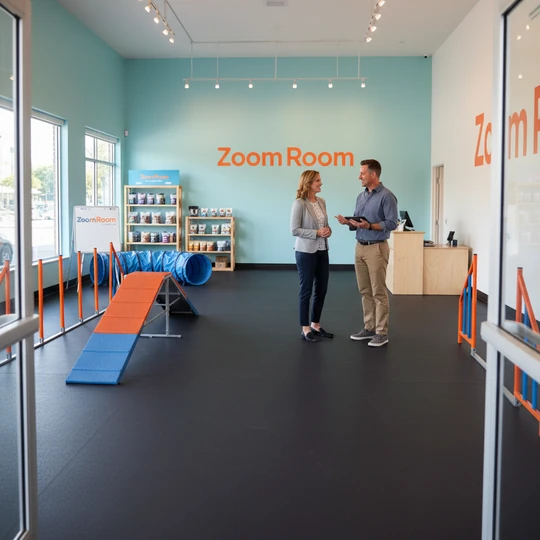
Zoom Room, ranked number one in dog training by Entrepreneur in 2026, operates with a total investment starting at $302,000. For buyers at the upper end of a $200K budget with financing options, it represents a proven concept in a growing industry.
Request InfoThis is not an offer to sell a franchise. An offer can only be made through a Franchise Disclosure Document. Financial performance representations are available in Item 19 of our Franchise Disclosure Document. Contact us to request our FDD.