
Best Franchises for Suburban Markets: Where Demographics and Demand Align
Suburban markets represent the ideal operating environment for many franchise concepts. The combination of residential density, household income, family demographics, and consumer spending patterns creates conditions where well-chosen franchises can thrive. But not every franchise concept translates equally to suburban settings. Understanding which models are built for suburbs versus cities versus rural markets is critical to making the right investment.
Why Suburbs Are the Engine of Franchise Growth
The numbers tell the story. Approximately 55 percent of Americans live in suburban areas, and suburban households tend to have higher median incomes, larger family sizes, and more disposable spending than urban or rural counterparts. These demographics drive demand for exactly the kinds of services that franchise models deliver: convenience, quality, and consistency.
Suburban consumers also exhibit buying patterns that favor franchises. They drive to businesses rather than walking, which means a franchise doesn't need foot traffic from a bustling downtown street corner. Strip malls, neighborhood shopping centers, and mixed-use developments provide affordable retail space with ample parking, and the rental rates are typically 30 to 50 percent lower than comparable urban locations.
Perhaps most significantly for franchise investors, suburban markets are growing. Population migration from urban cores to suburbs accelerated in recent years, and new residential development continues to create pockets of demand in formerly underdeveloped areas. A franchise that opens in a growing suburb benefits from an expanding customer base without additional marketing spend.
Pet Services: The Suburban Advantage
Pet ownership correlates strongly with suburban living. Homes with yards, access to parks and trails, and family-oriented lifestyles all contribute to higher rates of dog ownership in suburbs compared to urban centers. The American Pet Products Association data shows that suburban households are more likely to own dogs and more likely to spend on pet services than their urban counterparts.
This demographic reality makes suburbs the natural home for pet service franchises. Dog training, daycare, grooming, and pet wellness concepts all benefit from the density of pet-owning households within a compact geographic radius. A suburban dog training franchise can draw clients from a three to five mile radius encompassing thousands of dog-owning families.
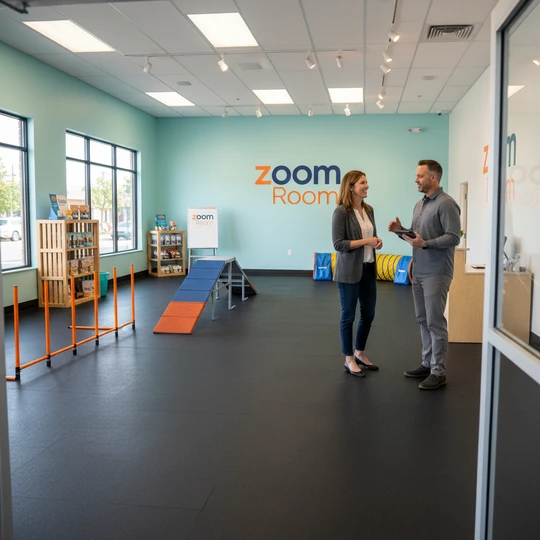
Zoom Room's model is particularly well-suited to suburban markets. The approximately 3,000-square-foot format fits naturally into suburban retail centers, the class schedule aligns with family routines (evening and weekend classes for working pet parents), and the community-building aspect of group training classes resonates with the social fabric of suburban neighborhoods. Ranked number one in dog training by Entrepreneur in 2026, the brand positions well in markets where pet ownership rates are highest.
The competitive landscape for pet services varies dramatically by suburb. Some markets have multiple competing pet businesses, while others are significantly underserved. Before investing, map every pet service provider within your target area and identify where gaps exist. A suburb with two dog daycares but no dedicated training facility represents a different opportunity than one where all categories are well-represented.
Children's Services and Education
Suburbs are defined by families, and families drive demand for children's services. Tutoring, enrichment programs, youth sports training, STEM education, and children's fitness franchises all find their strongest markets in suburban areas with high concentrations of school-age children.
The economics work because suburban parents invest heavily in their children's development. A tutoring franchise in an affluent suburb might charge $50 to $80 per hour with clients attending two to three sessions per week. An enrichment program targeting preschool through elementary age can build a roster of 100 to 200 families paying $150 to $300 per month for weekly sessions.
The critical metric is school-age population density. Research the number of children aged 5 to 18 within your target radius, the median household income, and the existing after-school and enrichment options. Suburbs with new housing developments and growing school enrollments are particularly attractive because demand is expanding naturally.
Fitness and Wellness in Suburban Settings
Suburban fitness franchises benefit from a customer base that's willing to commit to memberships and maintain routines. Unlike urban gyms where members might attend sporadically because of transit hassles and schedule unpredictability, suburban members tend to establish consistent weekly patterns. This translates to better retention rates and more predictable revenue.
Boutique fitness concepts (cycling, functional training, yoga, Pilates) thrive in suburbs where health-conscious consumers seek community and accountability along with exercise. Studios in the $150,000 to $350,000 investment range can build memberships of 200 to 400 active members within a 12 to 18 month ramp period.
The suburban fitness market is also less saturated than urban markets in many areas. While a city neighborhood might have ten fitness studios within walking distance, a suburban shopping center might be the only boutique option for a five-mile radius. This geographic buffer provides natural territory protection beyond whatever the franchise agreement specifies.
Home Services and Property Maintenance
Suburban homeownership rates are significantly higher than urban rates, and homeowners spend more on property maintenance than renters. This drives consistent demand for home cleaning, landscaping, pest control, painting, handyman services, and property restoration franchises.
The scale opportunity in suburban home services is compelling. A suburban market of 50,000 households might represent $100 million or more in annual home services spending. Capturing even a small fraction of that spending through a well-managed franchise can generate substantial revenue. And because suburban homes tend to be larger and more expensive than urban properties, the average ticket size for home services is typically 20 to 40 percent higher.
Seasonal patterns in suburban markets create natural marketing opportunities. Spring brings landscaping and exterior painting demand. Summer drives pest control and pool services. Fall means gutter cleaning and winterization. Winter brings holiday lighting installation and indoor renovation projects. A home services franchise that aligns its marketing calendar with these suburban rhythms maximizes customer acquisition efficiency.
Evaluating Suburban Markets: Key Data Points
Household income and growth trends. Look for suburbs with median household incomes above $75,000 and positive income growth trends. These markets have the spending power to support premium-priced franchise services and the demographic trajectory to sustain growth.
Population age distribution. Suburbs with large cohorts of 30 to 55 year olds tend to have the highest franchise demand. This demographic is simultaneously raising children, maintaining homes, investing in wellness, and caring for pets, making them the ideal customer for multiple franchise categories.
Pet ownership data. For pet service franchises, local pet ownership data is invaluable. Veterinary clinic density, pet store presence, and dog park availability all serve as proxies for pet ownership rates. A suburb with three veterinary clinics and an active dog park community has demonstrated demand for pet services.
New construction activity. Suburbs with active residential construction are markets in transition. New housing developments bring new families, new dogs, new children, and new demand for services. Timing your franchise opening to coincide with the maturation of a new residential development can accelerate your ramp to profitability.
Retail vacancy rates and lease terms. Low vacancy rates indicate a healthy commercial market but may mean higher rents and fewer location options. Moderate vacancy (5 to 10 percent) often provides the best balance: enough available space to negotiate favorable lease terms without signaling market weakness.
Frequently Asked Questions
- The strongest suburban franchise concepts serve the needs of family households: children's services, pet services, home maintenance, fitness, and convenience-oriented businesses. They operate in retail centers with parking, rely on repeat customers within a defined geographic radius, and benefit from higher household incomes and homeownership rates. Concepts that depend on foot traffic, tourism, or urban density typically perform better in city locations.
- It depends on the category, but suburban franchises often achieve better net margins because of lower rent and labor costs, even if top-line revenue is comparable. A franchise paying $3,000 per month in suburban rent versus $8,000 in an urban location keeps an extra $60,000 per year. Combined with lower wage expectations and less competitive labor markets, the suburban cost advantage can significantly improve profitability.
- Start with population and household data from the U.S. Census Bureau. Identify the total population, median household income, average household size, and age distribution within a 5 to 10 mile radius. Then assess competition: count every business in your category within that radius. Finally, talk to the franchisor about minimum market requirements and compare your data against their benchmarks.
- Suburban dog training franchises often benefit from higher dog ownership rates, more convenient parking, and larger average class sizes because families with yards are more likely to own dogs. The customer acquisition cost can also be lower because word-of-mouth spreads efficiently in community-oriented suburbs. Suburban locations may see stronger weekend enrollment as families make training part of their activity routine.
What makes a franchise well-suited for suburban markets? +
Are suburban franchises more profitable than urban ones? +
How do I know if my suburb can support a specific franchise? +
Do suburban dog training franchises perform differently than urban ones? +
Built for the Communities Where Dogs Live
Zoom Room's suburban-optimized model, approximately 3,000 square feet in neighborhood retail centers, serves the markets with the highest pet ownership rates. Ranked number one in dog training by Entrepreneur in 2026.
Request InfoThis is not an offer to sell a franchise. An offer can only be made through a Franchise Disclosure Document. Financial performance representations are available in Item 19 of our Franchise Disclosure Document. Contact us to request our FDD.