
Are Dog Franchises Profitable? A Framework for Evaluating
The honest answer is: some are, and some aren't. Profitability isn't baked into the franchise model itself -- it depends on the category, the brand, your market, and your execution. Here's how to evaluate whether a specific dog franchise can be profitable for you.
Profitability Is Not a Yes or No Question
Asking "are dog franchises profitable" is like asking "are restaurants profitable." Some are wildly successful. Others close within a year. The category alone doesn't determine the outcome.
What determines profitability is the intersection of several factors: the revenue model, the cost structure, the market conditions, the strength of the brand, and the owner's execution. Understanding each of these factors gives you a framework for evaluating any specific franchise opportunity.
The pet industry's structural growth -- surpassing $157 billion annually with more than 65 million dog-owning households -- provides a favorable backdrop. But a favorable industry doesn't guarantee a profitable business. You need to dig deeper.
Revenue Model: Recurring vs. One-Time
The most important question about any dog franchise is: how do customers pay, and how often do they come back?
Franchises built on recurring revenue -- memberships, subscriptions, and multi-class packages -- have a structural advantage. Each month starts with a base of committed revenue from existing customers. Growth compounds because new customers add to the base rather than replacing churned ones.
Zoom Room operates on this model, with class packages and memberships driving ongoing revenue and an 87% customer retention rate. That retention means a large portion of revenue is predictable and repeating, which improves both cash flow and long-term profitability.
One-time transaction models -- where each grooming appointment, retail purchase, or boarding stay is a standalone event -- require continuous customer acquisition. Marketing costs stay high, revenue is less predictable, and the business doesn't compound in the same way.
When evaluating a dog franchise, ask: What percentage of revenue comes from recurring sources? How long does the average customer stay? What's the lifetime value of a customer? These metrics tell you more about profitability potential than top-line revenue numbers alone.
Margins: What You Keep from What You Earn
Revenue means nothing if your costs eat it all. Understanding the margin structure of a dog franchise is critical.
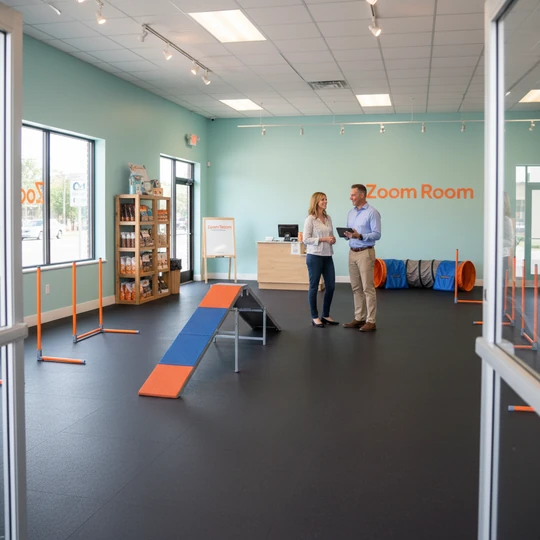
Rent and occupancy: This is typically the largest fixed cost. Training franchises in standard retail space generally have lower occupancy costs than daycare operations that need large, purpose-built facilities. Zoom Room's model uses standard retail space, keeping occupancy costs in line with typical commercial leases.
Labor: The second-largest cost. Training models with small teams (like a two-person floor) protect margins better than daycare models requiring one handler per 10-15 dogs. Fewer employees also means less complexity in scheduling, HR, and management.
Cost of goods: For training franchises, cost of goods is minimal -- you're selling expertise and instruction, not physical products. Retail franchises have significant inventory costs. Grooming businesses have supply costs but no inventory to manage.
Marketing: Customer acquisition costs are ongoing. Franchises with strong brand recognition and high retention need to spend less on marketing per customer than unknown brands with high churn. This is an under-appreciated margin advantage of established franchise systems.
Insurance: Owner-participatory training models typically see lower insurance costs than daycare or boarding operations where dogs are left in the business's care without their owners present.
Customer Lifetime Value: The Hidden Driver
Customer lifetime value (CLV) is the total revenue a single customer generates over their entire relationship with your business. It's one of the most important metrics for evaluating franchise profitability, and it's often overlooked.
A dog training franchise where the average customer stays two years and spends $200 per month has a CLV of $4,800. Compare that to a grooming business where the average customer comes every six weeks and spends $75, staying for 18 months -- that's a CLV of about $975.
Higher CLV means you can invest more to acquire each customer while remaining profitable. It also means you need fewer total customers to hit your revenue targets, which reduces marketing pressure and operational complexity.
Training franchises tend to have high CLV because of the progressive nature of the service. A puppy owner starts with socialization, moves to obedience, tries agility or nose work, and comes back with their next dog. The relationship deepens over time rather than plateauing.
When evaluating a dog franchise, ask about average customer tenure, monthly spend per customer, and retention rates. If the franchisor doesn't track or share these metrics, that's a yellow flag about how well they understand their own business.
How to Get Real Profitability Data
The Franchise Disclosure Document is your best source of objective financial information. Item 19 may include revenue data. Item 7 details the total investment. Item 20 lists every franchisee you can call directly.
But the FDD won't tell you everything. Here's how to fill the gaps:
Call existing franchisees. Ask them: How long did it take to reach profitability? What were your biggest unexpected costs? What would you do differently? Would you do it again? The patterns you hear across multiple calls will give you a reliable picture.
Build a local financial model. Take any revenue data from Item 19 and subtract realistic expenses based on your specific market: rent, labor costs, insurance, utilities, and marketing. Run the model at conservative, moderate, and optimistic scenarios. If the business only works in the best case, reconsider.
Understand the ramp-up curve. Most dog franchises take 12 to 24 months to reach profitability. Your working capital needs to sustain you through that period. Factor in both the financial and emotional ramp -- the first year of any business is demanding.
Look at unit economics over time. A franchise that shows improving profitability as locations mature is demonstrating that the model works once the customer base builds. Ask the franchisor about how year-one, year-two, and year-three locations compare.
Frequently Asked Questions
- Dog training franchises tend to have favorable profitability profiles due to recurring revenue, lean staffing, standard retail space, and high customer retention. However, the most profitable franchise for you depends on your market, capital, and involvement level. Review Item 19 financial data and talk to existing franchisees to evaluate specific opportunities.
- Most dog franchises take 12 to 24 months to reach profitability. The timeline depends on how quickly you build your customer base, your operating costs, and whether the revenue model is based on recurring or one-time income. Make sure your working capital covers this ramp-up period.
- Customer lifetime value (CLV) is the total revenue one customer generates over their entire relationship with your business. Higher CLV means you need fewer customers, can invest more in acquisition, and build a more sustainable business. Training franchises with membership models and high retention tend to have the strongest CLV in the pet category.
- Dog-focused franchises -- particularly training -- tend to have favorable margins due to lower facility and staffing costs compared to daycare or boarding. They also benefit from recurring revenue and high customer lifetime value. However, profitability varies within every category, so evaluate specific brands rather than relying on category-level generalizations.
- The Franchise Disclosure Document (FDD) is the primary source. Item 19 may contain revenue data, Item 7 shows the total investment, and Item 20 lists current and former franchisees you can contact directly. Calling existing franchisees is the most reliable way to get honest financial performance information.
What type of dog franchise is most profitable? +
How long does it take for a dog franchise to become profitable? +
What is customer lifetime value and why does it matter for dog franchises? +
Are dog franchises more profitable than other pet franchise types? +
Where can I find financial performance data for a dog franchise? +
See the Data Behind Zoom Room's Model
Zoom Room's recurring revenue model, 87% customer retention, and lean operating structure are designed for franchisee profitability. Request the FDD to evaluate the numbers.
Request InfoThis is not an offer to sell a franchise. An offer can only be made through a Franchise Disclosure Document. Financial performance representations are available in Item 19 of our Franchise Disclosure Document. Contact us to request our FDD.