
Best Franchises for Small Towns: What Actually Works Outside Major Metros
Most franchise content assumes you are opening in a market of 500,000 or more people. But approximately 60 million Americans live in communities with fewer than 50,000 residents. Small-town franchise ownership has a different set of rules, advantages, and limitations. Understanding them is the difference between building a thriving community business and struggling against demographics that cannot support your concept.
Why Small Towns Are Different for Franchising
Small-town franchising inverts several assumptions that hold true in metro markets. In a city, the challenge is differentiation: standing out among dozens of competitors. In a small town, the challenge is demand sufficiency: ensuring enough customers exist within a reasonable drive radius to sustain the business.
The math is straightforward but often ignored. If a franchise location needs 200 recurring customers to reach profitability, and the town has 15,000 residents, you need roughly 1.3 percent of the population as active customers. That's achievable for essential services but potentially impossible for niche concepts. A boutique cycling studio might thrive in a suburb of 200,000 but cannot generate enough members in a town of 12,000.
The advantages of small-town franchising are real: lower real estate costs (often 40 to 60 percent less than metro), less direct competition, stronger community loyalty, and the ability to become the dominant or only provider in your category. These advantages can produce excellent economics if the concept matches the market.
Home Services: The Natural Small-Town Fit
Home services franchises, including cleaning, landscaping, pest control, handyman services, and restoration, are among the most natural fits for small towns. Every homeowner needs these services regardless of market size, and the mobile model means you can serve a wide geographic area from a central base.
In small towns, home services franchisees often benefit from being the only branded, professionally managed option in their category. While individual contractors handle most home maintenance in rural areas, a franchise with professional branding, insurance, and consistent quality can capture market share quickly from informal competitors who lack those attributes.
The economics can be particularly attractive because real estate costs (your office or garage) are minimal, and labor costs are often 20 to 30 percent lower than in metro markets. A home cleaning franchise that requires $80,000 in a small town might require $120,000 in a metro area for the same concept, while serving comparable revenue potential within a broader service radius.
Pet Services in Community-Centered Markets
Pet ownership rates are often higher in suburban and small-town markets than in urban centers. Houses with yards mean more dogs, and community-oriented lifestyles mean more time spent with pets. The pet industry's growth past $157 billion is not exclusively an urban phenomenon; small-town pet owners spend on their animals with the same dedication as their metro counterparts.
The key distinction for small-town pet franchises is the model's minimum population requirement. A large-format dog daycare franchise that needs a population base of 200,000 or more to generate sufficient enrollment won't work in a town of 30,000. But a dog training franchise with a compact footprint and a class-based model can potentially serve a smaller market because the service area extends to surrounding communities within a 20 to 30 minute drive.
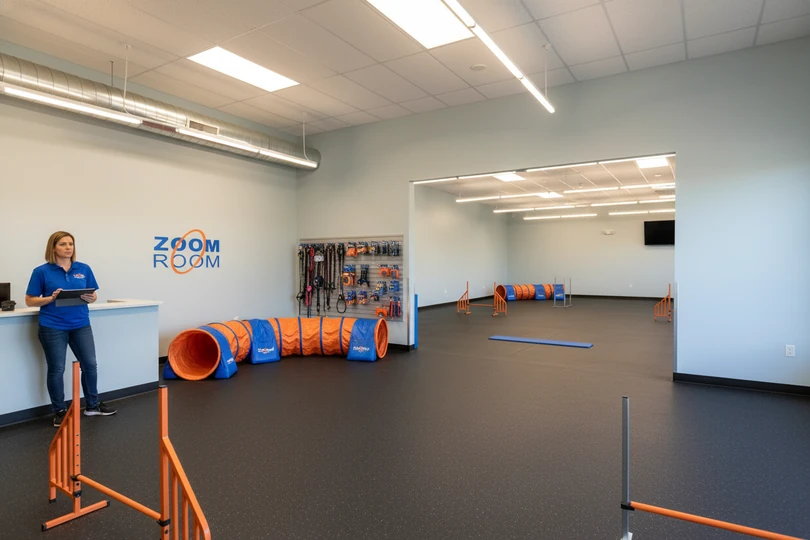
Zoom Room operates in approximately 3,000 square feet with just two staff per shift, making it more adaptable to moderate-sized markets than space-intensive daycare concepts. The training model also benefits from the community dynamic that's strong in smaller towns: word-of-mouth travels faster, class cohorts become social groups, and customer loyalty runs deeper when the business is part of the community fabric.
Food and Quick-Service: Proven but Competitive
Quick-service and fast-casual food franchises are the most common franchises in small towns, and for good reason: everyone eats. Established brands like Subway, Dairy Queen, and Taco Bell have thousands of locations in towns under 25,000 people. The business model is well-understood by lenders, the brand recognition drives traffic, and the operational systems are designed for markets of all sizes.
The caution is competition and saturation. Many small towns already have the major QSR brands represented, and adding another food option to a market with limited dining demand can be a zero-sum game. Before investing in a food franchise in a small town, count the existing restaurants and fast-food locations, estimate the market's total dining spend, and assess whether there's genuine room for another option.
Also consider the labor implications. Small towns often have limited labor pools, and food franchises require significant staffing across long operating hours. Recruiting reliable workers in a town where every employer is competing for the same limited talent base is a genuine operational challenge.
Fitness and Education: Viable With the Right Model
Small-town fitness franchising works best with broad-appeal concepts rather than niche offerings. A general fitness center or a circuit-training studio appeals to a wider demographic than a specialized cycling or barre studio. The goal is to capture as large a percentage of the local population as possible because the total addressable market is inherently limited.
24-hour fitness models can work well in small towns because they serve a market that often lacks dedicated gym facilities. The automated, unstaffed-hours model keeps labor costs low while providing a service that might not otherwise exist in the community. Total investments for small-format 24-hour gyms typically range from $100,000 to $300,000.
Education franchises, particularly tutoring and children's enrichment, can succeed in small towns when anchored to the local school population. If the town has 3,000 to 5,000 school-age children, a tutoring franchise can build a viable enrollment base. The key is understanding the local education landscape: are parents already seeking supplemental education, or would you need to create demand from scratch?
How to Evaluate Franchise Viability in a Small Market
Population and drive-time analysis. Count the total population within a 15 to 20 minute drive of your proposed location. In metro areas, the relevant radius might be three to five miles. In small towns, it can be 20 to 30 miles. Many franchises require a minimum population of 30,000 to 50,000 within the service area, so map this carefully.
Competition audit. In a small town, one competitor can represent 50 percent market share in your category. Identify every direct and indirect competitor within your service area, estimate their revenue, and assess what share of the remaining market you can realistically capture.
Franchisor experience in small markets. Ask the franchisor specifically about their existing franchisees in towns of similar size. How do those locations perform compared to metro locations? If the franchise has zero experience in markets your size, you're essentially a test case, which increases risk.
Real estate advantage calculation. Quantify the real estate savings. If your lease is $1,500 per month instead of $5,000 per month, that's $42,000 per year in savings that flows directly to your bottom line. This advantage can offset lower revenue volumes and make a concept profitable in a small town that would struggle to break even in a metro market.
Community integration plan. Small-town businesses succeed through deep community involvement: sponsoring local teams, participating in town events, building personal relationships with customers. If you're not already part of the community or willing to become an active member, franchise ownership in a small town is significantly harder.
Frequently Asked Questions
- Home services, pet services, general fitness, quick-service restaurants, and children's education franchises have the strongest track records in small-town markets. The common thread is broad demand: services that most households need regardless of market size. Niche concepts with narrow target demographics generally struggle in towns under 30,000 people because the customer base is simply too small.
- It depends on the concept, but most brick-and-mortar franchises need a population of at least 20,000 to 30,000 within a reasonable drive radius to achieve viable enrollment or customer volume. Home-based and mobile franchises can work in smaller markets because they serve wider areas. Always ask the franchisor about their minimum population requirements and verify them against actual performance data from similarly sized markets.
- Real estate and labor costs are typically 30 to 50 percent lower in small towns compared to metro areas, which reduces both initial investment and ongoing operating expenses. However, the franchise fee, equipment costs, and training expenses are usually the same regardless of location. The net result is a lower total investment, but the savings are concentrated in lease and labor rather than franchise system costs.
- Pet ownership rates are often higher in small towns and suburban areas than in cities, which creates genuine demand for pet services. The key is matching the concept's scale to the market size. A compact dog training franchise requiring 3,000 square feet and serving a 20-mile radius can work in markets that a large daycare facility with a $1 million buildout cannot. Evaluate the pet-owning population within your service area, not just the total population.
What franchises work in small towns? +
How small is too small for a franchise? +
Are franchises cheaper to open in small towns? +
Do pet franchises work in small towns? +
A Compact Franchise Model Built for Community Markets
Zoom Room's approximately 3,000-square-foot format and lean staffing model make it adaptable to markets where larger pet franchise concepts cannot operate. Ranked number one in dog training by Entrepreneur in 2026.
Request InfoThis is not an offer to sell a franchise. An offer can only be made through a Franchise Disclosure Document. Financial performance representations are available in Item 19 of our Franchise Disclosure Document. Contact us to request our FDD.