Market Analysis
The Business Case for a Dog Training Franchise in Charlotte, North Carolina
With 14 dog training businesses serving a metro of 1,433,459, Charlotte has room for a differentiated franchise concept. The numbers tell an interesting story about opportunity in this market.
| Charlotte, NC — Market Snapshot | |
|---|---|
| MSA Population | 1,433,459 |
| Population Growth (2020–2025) | 8.9% |
| Median Household Income | $89,649 |
| Pet Ownership Rate (State) | 56.2% |
| Dog Ownership % | 42.3% |
| Avg. Pet Spending/Household | $1,410 |
| Dog Training Businesses | 14 |
| Avg. Commercial Rent ($/sqft) | $22 |
| Walk Score | 26 |
Key employers: Atrium Health, Bank of America, Lowe's, Honeywell, Duke Energy
Why Charlotte's Demographics Favor Dog Training
Charlotte's metro area has a population of 1,433,459 with rapid growth of 8.9% since 2020. This growth pattern signals an expanding market for service-based businesses, particularly those serving pet owners.
With a median household income of $89,649 — well above the national average — Charlotte households have the spending power to invest in premium pet services. North Carolina's pet ownership rate of 56.2% means a significant portion of local households are potential customers for dog training and socialization services.
The demographic profile supports a socialization-focused franchise model — one where dog owners participate in group classes, build community, and return weekly. Markets with Charlotte's combination of income and pet ownership tend to produce strong customer retention and high lifetime value.
Competitive Landscape: Dog Training in Charlotte
Charlotte's 14 dog training businesses yield a ratio of roughly one provider per 102,000 residents — among the lowest provider densities of any major metro in the Southeast. This scarcity is amplified by the market's rapid growth: Charlotte has added more than 100,000 residents since 2020, and the service infrastructure has not scaled in proportion. The result is a widening gap between demand and supply, particularly in the fast-growing southern and northern suburbs.
The existing competitive set is dominated by independent trainers working from private properties and a small number of pet resort facilities that bundle training with daycare and boarding. The NoDa, South End, and Plaza Midwood neighborhoods — Charlotte's cultural and nightlife corridors — have attracted dense concentrations of young professionals with dogs, yet have no dedicated group-class training facility. The suburban boom towns of Ballantyne, Huntersville, and Mooresville face a similar gap: rapid residential development with minimal pet service infrastructure.
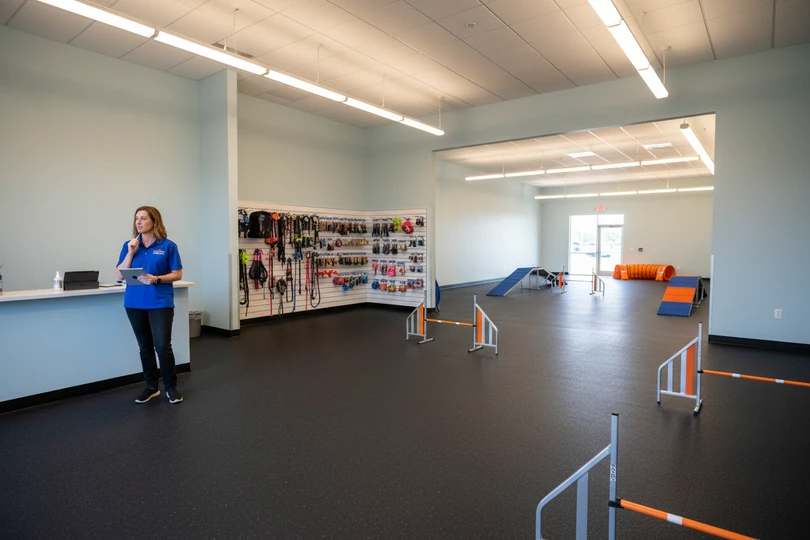
A franchise model built on group socialization classes in retail-format space addresses Charlotte's specific shortage. The concept's compact footprint and two-person operational model allow it to occupy the type of strip-center and mixed-use retail space that Charlotte is building rapidly, without the buildout complexity and staffing burden of larger pet care formats.
Dog Ownership and Pet Spending in North Carolina
North Carolina's 42.3% dog ownership rate exceeds the national average, and Charlotte's demographics push that figure higher in the metro's most affluent trade areas. The city's identity as a transplant destination is central to understanding its pet market: residents relocating from the Northeast, Midwest, and West Coast often bring established expectations around pet services — and their dogs. The relocation cycle itself generates a surge in demand for training and socialization, as dogs adjusting to new homes, new neighborhoods, and new routines are prime candidates for structured behavioral support.
Average annual pet spending of $1,410 per household is growing, propelled by the same demographic shift driving Charlotte's broader economy. Bank of America, Wells Fargo, Honeywell, and Lowe's anchor a white-collar employment base where household incomes comfortably support premium pet services. These are dual-income households with busy schedules who value structured programs with fixed class times — the kind of predictable, appointment-based model that generates consistent revenue.
The pet services growth trajectory is especially pronounced in high-migration markets like Charlotte. Each year's wave of new residents adds incremental demand for training services that independent providers are not scaled to absorb. For a franchise with systems designed to capture and convert new-mover demand, Charlotte's growth pattern represents a built-in customer acquisition engine.
Investment Context: Operating a Franchise in Charlotte
Charlotte's average commercial rent of approximately $22.00 per square foot offers a strong value proposition for a market growing at 8.9%. The metro's ongoing construction boom has produced ample new retail inventory in the suburban growth corridors — Ballantyne, Lake Norman, University City — where lease terms can be particularly favorable as landlords fill newly built centers. For a franchise concept requiring roughly 3,000 square feet of retail space, Charlotte offers numerous viable sites in high-traffic locations anchored by Harris Teeter, Publix, or Target, often with tenant improvement allowances that reduce buildout costs.
North Carolina does not require franchise registration, which eliminates a regulatory step that can add weeks or months in states like New York, Maryland, or Illinois. Charlotte's generally efficient permitting process and business-friendly regulatory environment further accelerate the path from signed agreement to grand opening.
The total investment of $302,523 to $464,712 aligns well with Charlotte's market economics. The metro's $89,649 median household income provides strong spending capacity, while operating costs remain moderate compared to Northeast and West Coast markets. Charlotte's combination of high incomes, rapid growth, and reasonable rents creates a favorable investment-to-opportunity ratio. Request a Franchise Disclosure Document for detailed financials and territory availability in the Charlotte metro.
Franchise vs. Independent in Charlotte
Charlotte's transplant-heavy population creates a specific challenge for independent dog trainers: a large share of the customer base has no local network, no established trainer relationship, and no word-of-mouth connections. These consumers default to Google, Yelp, and neighborhood social media groups to find services. A franchise with established SEO infrastructure, a national reviews profile, and professional branding captures this search-first demographic far more effectively than an independent trainer with limited online presence.
The geographic sprawl of the Charlotte metro compounds the independent operator's challenge. The market stretches from Mooresville in the north to Fort Mill, SC in the south, and from Gastonia in the west to Matthews in the east. Building brand awareness across this footprint as a solo operator is exceptionally difficult. A franchise's centralized marketing systems, geo-targeted digital advertising, and multi-location scalability are designed for exactly this kind of spread-out, multi-node metro.
Charlotte's competitive labor market — where Bank of America, Atrium Health, Honeywell, and Lowe's set the standard for compensation and benefits — makes it difficult for any small business to recruit experienced specialists. A franchise that embeds expertise in a structured curriculum can hire from the broader pool of customer-service-oriented candidates, including graduates from UNC Charlotte and the metro's numerous colleges, and develop their dog training skills through a proven certification system. This approach is more scalable and more sustainable than competing for scarce experienced trainers.
Frequently Asked Questions
- Charlotte's combination of a 1,433,459 population, 56% pet ownership rate, and median household income of $89,649 makes it a strong market for pet services. The ratio of approximately one dog trainer per 102,390 residents suggests meaningful room for new entrants.
- The Charlotte metro area has approximately 14 dog training businesses. The majority are independent operators offering private lessons. Very few provide the ongoing, group-class socialization model that drives recurring revenue and long-term customer retention.
- A dog training franchise typically requires a total investment in the range of $302,523 to $464,712, depending on location, buildout, and market conditions. Charlotte's commercial rent of approximately $22.00 per square foot helps keep the overall investment competitive. Contact us to request our Franchise Disclosure Document for detailed financial information.
- No. North Carolina does not require franchise registration, which simplifies the startup process. Regardless of state requirements, franchisors must provide a Franchise Disclosure Document at least 14 days before any agreement is signed, per FTC requirements.
Is Charlotte a good market for a dog training franchise? +
How many dog training businesses are in Charlotte? +
What does it cost to open a dog training franchise in Charlotte? +
Does North Carolina require franchise registration? +
Explore Territory Availability in Charlotte
See if your preferred Charlotte-area territory is available. Our team will walk you through the market data and next steps.
Request InfoThis is not an offer to sell a franchise. An offer can only be made through a Franchise Disclosure Document. Financial performance representations are available in Item 19 of our Franchise Disclosure Document. Market data sourced from U.S. Census Bureau, APPA, and public records. Contact us to request our FDD.