
Market Analysis
Franchise Opportunities in Atlanta: What the Data Says About the Pet Market
With 10 dog training businesses serving a metro of 2,544,957, Atlanta has room for a differentiated franchise concept. The numbers tell an interesting story about opportunity in this market.
| Atlanta, GA — Market Snapshot | |
|---|---|
| MSA Population | 2,544,957 |
| Population Growth (2020–2025) | 7.3% |
| Median Household Income | $82,339 |
| Pet Ownership Rate (State) | 55.1% |
| Dog Ownership % | 40.8% |
| Avg. Pet Spending/Household | $1,410 |
| Dog Training Businesses | 10 |
| Avg. Commercial Rent ($/sqft) | $22 |
| Walk Score | 48 |
Key employers: Delta Air Lines, Home Depot, UPS, Coca-Cola, Emory Healthcare
Why Atlanta's Demographics Favor Dog Training
Atlanta's metro area has a population of 2,544,957 with steady growth of 7.3% since 2020. This growth pattern signals an expanding market for service-based businesses, particularly those serving pet owners.
With a median household income of $82,339 — well above the national average — Atlanta households have the spending power to invest in premium pet services. Georgia's pet ownership rate of 55.1% means a significant portion of local households are potential customers for dog training and socialization services.
The demographic profile supports a socialization-focused franchise model — one where dog owners participate in group classes, build community, and return weekly. Markets with Atlanta's combination of income and pet ownership tend to produce strong customer retention and high lifetime value.
Competitive Landscape: Dog Training in Atlanta
Atlanta's approximately 10 dog training businesses serve a metro population of 2,544,957 — roughly one trainer per 254,000 residents. That ratio places Atlanta among the most underserved large metros in the Southeast for structured dog training. The gap is particularly notable in high-growth corridors like the Beltline-adjacent neighborhoods, where new residential density has outpaced service infrastructure.
Most existing providers in the Atlanta market are solo practitioners running private-session models out of home facilities or rented fields. The Buckhead and Midtown corridors — where young professionals with disposable income cluster — have no dedicated group-class training facility. Franchise-format dog daycares exist in Perimeter and Sandy Springs, but these are fundamentally different businesses with higher buildout costs, larger square footage requirements, and staffing ratios that compress margins.
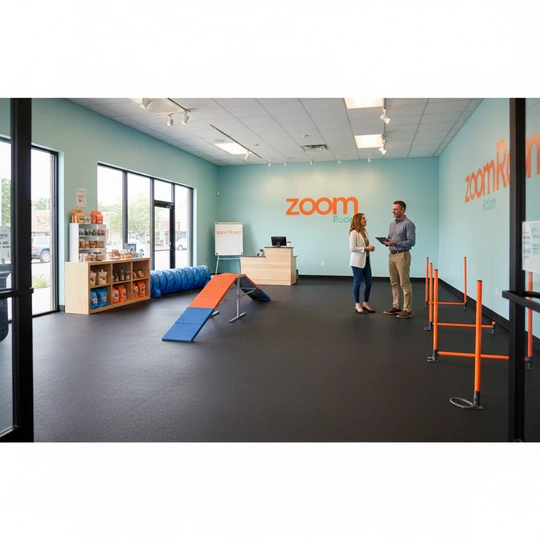
A socialization-focused franchise operating in standard retail space fills a distinct gap: recurring group classes on a two-person floor, with a footprint and cost structure that daycare and boarding concepts cannot match. In a metro where the film and tech industries have drawn tens of thousands of new residents since 2020, that gap is widening.
Dog Ownership and Pet Spending in Georgia
Georgia's 40.8% dog ownership rate translates to a substantial addressable market in metro Atlanta, where household density amplifies the raw percentage. Average annual pet spending of $1,410 per household is notable, but the more telling indicator is the composition of that spending: Atlanta pet owners are increasingly allocating dollars toward services rather than products, mirroring a national shift that favors training, wellness, and socialization over commodity goods.
Atlanta's pet culture has distinct local characteristics that amplify demand for structured training. The city's large apartment and condo inventory — particularly along the Beltline and in Midtown — means many dog owners live in spaces where behavioral training is not optional but essential. Dogs in urban environments need impulse control, leash manners, and socialization with other dogs and people, which drives demand for exactly the kind of recurring group-class model that generates consistent revenue.
The pet services sector's growth trajectory is especially relevant in Atlanta, where the influx of young professionals from the tech and entertainment industries has brought a demographic that treats pet care as a non-negotiable household expense. This cohort tends to research providers online, read reviews, and commit to programs rather than one-off sessions.
Investment Context: Operating a Franchise in Atlanta
Atlanta's commercial real estate market offers a favorable setup for retail-format franchises. Average rents of approximately $22.00 per square foot are competitive for a top-10 metro, and the market's suburban sprawl provides ample strip-center and inline retail inventory in high-traffic locations near Kroger, Publix, and Target-anchored centers. A franchise concept requiring roughly 3,000 square feet of standard retail space can find viable sites across multiple trade areas without competing for the premium space that restaurants and medical tenants demand.
Georgia does not require franchise registration, which eliminates a layer of administrative delay that exists in states like Maryland, New York, and Illinois. The timeline from signing a franchise agreement to opening can be meaningfully shorter as a result. Georgia's business-friendly regulatory environment also extends to permitting and zoning, which tends to move faster in the Atlanta suburbs than in comparable metros.
The total investment range of $302,523 to $464,712 positions well against Atlanta's economics. With the metro's strong household incomes and the relatively moderate cost of commercial space, the ratio of investment to addressable market is attractive. Contact the franchise development team to request a Franchise Disclosure Document with detailed financial information.
Franchise vs. Independent in Atlanta
Atlanta's sheer geographic scale makes independent brand-building particularly challenging. The metro spans multiple counties, and a solo trainer working out of a single location in Decatur has limited visibility to potential clients in Roswell, Alpharetta, or East Atlanta. A franchise model addresses this through centralized digital marketing, SEO infrastructure, and brand recognition that functions across the entire metro from day one.
The labor market dynamics in Atlanta further favor a franchise approach. The city's booming economy — anchored by Delta, Home Depot, UPS, and a rapidly growing tech sector — means competition for skilled workers is intense across industries. An independent dog training business must find experienced trainers, a narrow and expensive talent pool. A franchise that embeds expertise in the curriculum itself can hire enthusiastic, trainable staff and develop them through a proven system, sidestepping the hiring bottleneck that constrains most independent operators.
Atlanta consumers are also notably brand-conscious and review-driven. In a market where Google reviews and social media presence heavily influence purchasing decisions, a franchise with an established national reputation and consistent five-star review generation systems has a structural advantage over a new independent business starting with zero online presence.
Frequently Asked Questions
- Atlanta's combination of a 2,544,957 population, 55% pet ownership rate, and median household income of $82,339 makes it a strong market for pet services. The ratio of approximately one dog trainer per 254,496 residents suggests meaningful room for new entrants.
- The Atlanta metro area has approximately 10 dog training businesses. The majority are independent operators offering private lessons. Very few provide the ongoing, group-class socialization model that drives recurring revenue and long-term customer retention.
- A dog training franchise typically requires a total investment in the range of $302,523 to $464,712, depending on location, buildout, and market conditions. Atlanta's commercial rent of approximately $22.00 per square foot helps keep the overall investment competitive. Contact us to request our Franchise Disclosure Document for detailed financial information.
- No. Georgia does not require franchise registration, which simplifies the startup process. Regardless of state requirements, franchisors must provide a Franchise Disclosure Document at least 14 days before any agreement is signed, per FTC requirements.
Is Atlanta a good market for a dog training franchise? +
How many dog training businesses are in Atlanta? +
What does it cost to open a dog training franchise in Atlanta? +
Does Georgia require franchise registration? +
Explore Territory Availability in Atlanta
See if your preferred Atlanta-area territory is available. Our team will walk you through the market data and next steps.
Request InfoThis is not an offer to sell a franchise. An offer can only be made through a Franchise Disclosure Document. Financial performance representations are available in Item 19 of our Franchise Disclosure Document. Market data sourced from U.S. Census Bureau, APPA, and public records. Contact us to request our FDD.