
Market Analysis
Franchise Opportunities in Amarillo: What the Data Says About the Pet Market
Amarillo's growing population, strong household incomes, and high pet ownership create favorable conditions for a dog training franchise. Here's a data-driven look at what makes this market worth evaluating.
| Amarillo, TX — Market Snapshot | |
|---|---|
| MSA Population | 168,718 |
| Population Growth (2020–2025) | 6.5% |
| Median Household Income | $64,581 |
| Pet Ownership Rate (State) | 57.4% |
| Dog Ownership % | 43.8% |
| Avg. Pet Spending/Household | $1,410 |
| Dog Training Businesses | 18 |
| Avg. Commercial Rent ($/sqft) | $18 |
| Walk Score | 30 |
Why Amarillo's Demographics Favor Dog Training
Amarillo's metro area has a population of 168,718 with steady growth of 6.5% since 2020. This growth pattern signals an expanding market for service-based businesses, particularly those serving pet owners.
With a median household income of $64,581 — above the national average — Amarillo households have the spending power to invest in premium pet services. Texas's pet ownership rate of 57.4% means a significant portion of local households are potential customers for dog training and socialization services.
The demographic profile supports a socialization-focused franchise model — one where dog owners participate in group classes, build community, and return weekly. Markets with Amarillo's combination of income and pet ownership tend to produce strong customer retention and high lifetime value.
Competitive Landscape: Dog Training in Amarillo
Amarillo has approximately 18 dog training businesses for a metro population of 168,718. That one-per-9,400 ratio looks competitive on paper, but a closer look at the provider landscape reveals a different picture. The majority of Amarillo's trainers operate informally — ranch-style operations on rural properties, part-time instructors working out of their homes, or hunting and working-dog specialists catering to the Panhandle's agricultural community. Very few are structured retail businesses, and almost none offer indoor group socialization classes.
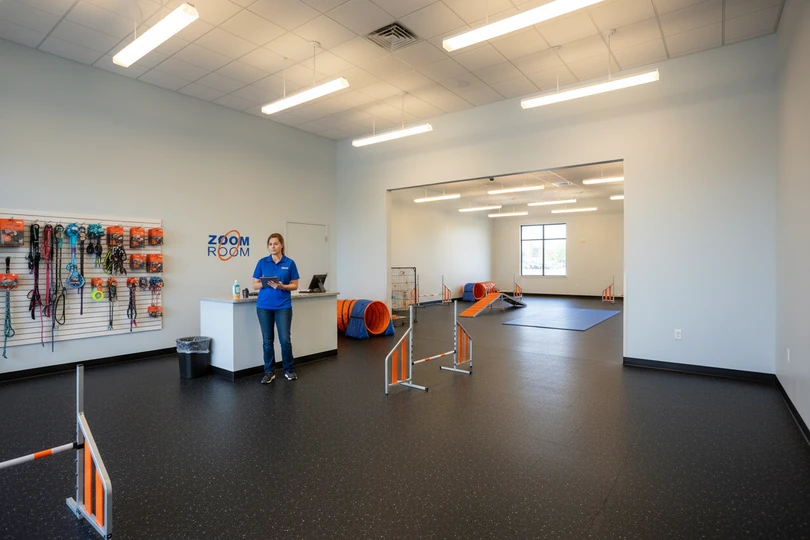
This matters because Amarillo's climate presents a distinct challenge for dog owners. Summer temperatures routinely exceed 100 degrees and spring brings intense wind and dust storms, making outdoor training impractical for significant stretches of the year. An indoor, climate-controlled training facility offering year-round classes would hold a structural advantage over the field-based trainers that dominate the current landscape. A franchise model designed for retail space is purpose-built for this environment.
The Wolflin and Coulter Road commercial corridors represent the metro's primary retail activity centers, drawing customers from across the city and surrounding communities like Canyon, Bushland, and Hereford. Amarillo functions as the regional hub for a vast geographic area, meaning a training facility in the city could pull customers from well beyond the metro boundary.
Dog Ownership and Pet Spending in Texas
Texas has a dog ownership rate of 43.8% of households, and Amarillo almost certainly exceeds that figure. In the Panhandle, dogs are woven into daily life — not just as companions but as working animals on ranches and farms. But the pet ownership profile is shifting. As Amarillo's economy has diversified beyond ranching and agriculture, the city has seen growth in professional and healthcare employment that brings a different type of dog owner: one who views training as a service to purchase rather than a skill to develop independently.
Average pet spending in the region runs approximately $1,410 per household annually. While that sits below the national average, the context matters: Amarillo's cost of living is among the lowest of any metro in Texas. Housing costs run roughly 40% below the state average, which means a household earning $64,581 here retains considerably more after fixed expenses than that income would suggest. The effective discretionary spending power for pet services is higher than raw income comparisons indicate.
The Panhandle's isolation also creates an interesting market dynamic. Amarillo is over 100 miles from the next metro of any size in every direction. This geographic isolation means the city functions as a self-contained services market — residents do not drive to Lubbock or Oklahoma City for dog training. Any quality provider that establishes itself locally captures the full addressable market without cross-metro competition. The ongoing national growth in pet services is reaching smaller metros like Amarillo as consumer expectations set in larger cities filter outward.
Investment Context: Operating a Franchise in Amarillo
Commercial retail rents in Amarillo average approximately $18.00 per square foot annually. While that is higher per square foot than some larger Texas metros, the overall occupancy cost for a 3,000-square-foot space remains modest in absolute terms. Retail centers along Soncy Road, Coulter Road, and I-40 access roads offer strong traffic exposure. Amarillo's commercial real estate market has benefited from the metro's 6.5% population growth since 2020, but has not yet experienced the rent inflation seen in Austin, Dallas, or San Antonio.
The local economy reflects a distinctive mix. The Pantex Plant — the nation's primary nuclear weapons assembly and disassembly facility — provides a substantial base of highly compensated federal employees. Amarillo's healthcare sector (BSA Health System, Northwest Texas Healthcare System) has expanded steadily, and the meatpacking and agricultural processing industries provide employment breadth. Bell Helicopter's V-280 Valor tiltrotor program in Amarillo adds an aerospace-manufacturing dimension that most cities this size lack entirely.
Texas does not require franchise registration, allowing for a streamlined startup process. The total investment of $302,523 to $464,712 for a dog training franchise positions attractively in a market where operating costs are low and the customer base is geographically captive. Contact us to request the Franchise Disclosure Document for detailed financial information.
Franchise vs. Independent in Amarillo
An independent dog trainer starting from scratch in Amarillo faces months of brand building, customer acquisition, and trial-and-error in operations. A franchise model provides day-one brand equity, a proven curriculum, and marketing systems tested across dozens of markets.
The franchise advantage is particularly strong in metro areas like Amarillo, where consumers research options online before visiting. A franchise with strong SEO presence, consistent branding, and social proof from national reviews captures a disproportionate share of the discovery phase.
Perhaps most importantly, a franchise model in pet services benefits from centralized training systems. Rather than depending on finding an experienced dog trainer — a constrained labor pool — a franchise that puts expertise in the curriculum can hire for personality and train the system, dramatically expanding the available talent pool.
Frequently Asked Questions
- Amarillo's combination of a 168,718 population, 57% pet ownership rate, and median household income of $64,581 makes it a promising market for pet services. The ratio of approximately one dog trainer per 9,373 residents suggests a competitive but viable landscape.
- The Amarillo metro area has approximately 18 dog training businesses. The majority are independent operators offering private lessons. Very few provide the ongoing, group-class socialization model that drives recurring revenue and long-term customer retention.
- A dog training franchise typically requires a total investment in the range of $302,523 to $464,712, depending on location, buildout, and market conditions. Amarillo's commercial rent of approximately $18.00 per square foot helps keep the overall investment competitive. Contact us to request our Franchise Disclosure Document for detailed financial information.
- No. Texas does not require franchise registration, which simplifies the startup process. Regardless of state requirements, franchisors must provide a Franchise Disclosure Document at least 14 days before any agreement is signed, per FTC requirements.
Is Amarillo a good market for a dog training franchise? +
How many dog training businesses are in Amarillo? +
What does it cost to open a dog training franchise in Amarillo? +
Does Texas require franchise registration? +
Explore Territory Availability in Amarillo
See if your preferred Amarillo-area territory is available. Our team will walk you through the market data and next steps.
Request InfoThis is not an offer to sell a franchise. An offer can only be made through a Franchise Disclosure Document. Financial performance representations are available in Item 19 of our Franchise Disclosure Document. Market data sourced from U.S. Census Bureau, APPA, and public records. Contact us to request our FDD.