
You Hate Your Corporate Job. Is a Franchise the Answer?
That Sunday-night dread. The pointless meetings. The feeling that you are building someone else's dream. If you have been Googling "should I quit my corporate job and buy a franchise" at 2 a.m., you are not alone. Let's talk about what franchise ownership actually looks like for someone coming from the corporate world.
First, Let's Validate What You're Feeling
Hating your corporate job does not make you ungrateful. It makes you honest. There is a difference between a bad week and the slow realization that your career path no longer fits who you are. Maybe the politics wore you down. Maybe the layoffs made you realize you have no real security anyway. Maybe you just want to do something that feels like yours.
Whatever brought you here, the instinct to explore franchise ownership is worth taking seriously. But "I hate my job" is a starting point, not a business plan. The people who do best in franchising are not just running away from something. They are running toward something specific.
Shemeck Piatek spent years in corporate roles at Microsoft and Best Buy. The jobs were prestigious. The pay was solid. But she wanted to build something that felt personal, something connected to her community. She opened a Zoom Room location in Richmond, Virginia, and found that the skills she built in corporate, like managing teams, reading data, and thinking strategically, transferred directly into running her own business.
What Actually Transfers from Corporate to Franchise Ownership
Here is the good news: corporate experience is genuinely valuable in franchising. You already know how to manage budgets, lead people, follow systems, and hit targets. Those are the exact muscles franchise ownership requires.
Skills that translate well include project management, hiring and team leadership, marketing strategy, financial literacy, and customer relationship building. If you have managed a P&L, run a department, or launched a product, you have relevant experience.
But some corporate habits actually work against you. In corporate, you wait for approval. In a franchise, you make the call. In corporate, someone else handles the plumbing. As a franchise owner, you are the person who deals with everything, at least in the beginning. The shift from "employee mindset" to "owner mindset" is the hardest part of the transition, and it is also the most rewarding.
The best franchise systems are designed to bridge this gap. A concept like Zoom Room, for example, runs on a two-person floor model. That means you do not need a giant team to operate. You can be hands-on in the business, in the room with dogs and their people, while still applying your corporate strategic skills to growth and marketing.
The Financial Reality of Leaving Corporate
Let's be direct about money. Leaving a corporate salary is scary, and it should be. The people who transition successfully are the ones who plan carefully, not the ones who rage-quit on a Monday.
Before you put in your notice, you need a clear picture of your personal financial runway. Most franchise advisors suggest having 6 to 12 months of living expenses saved beyond your franchise investment. That cushion lets you focus on building the business without panicking about your mortgage.
Franchise investments vary widely. Some concepts require millions. Others, especially those that operate in standard retail spaces rather than custom-built facilities, have more accessible entry points. Understanding the total investment, including working capital, buildout, and the franchise fee, is step one. The Franchise Disclosure Document, or FDD, lays all of this out in detail.
Many corporate professionals use SBA loans, ROBS (Rollover for Business Startups) programs to tap retirement funds penalty-free, or a combination. The financing path depends on your personal situation, but options exist that you may not know about yet.
Not Every Franchise Fixes What You Hate About Corporate
This is the part nobody wants to hear: some franchises recreate the exact things you are trying to escape. Complex hierarchies. Disconnection from the actual work. A job that feels like a job.
If what you hate about corporate is feeling like a cog in a machine, look for franchise models where the owner is genuinely involved in the day-to-day experience. Some franchise categories, like fast food, can feel like you traded one middle-management role for another, just with higher stakes.
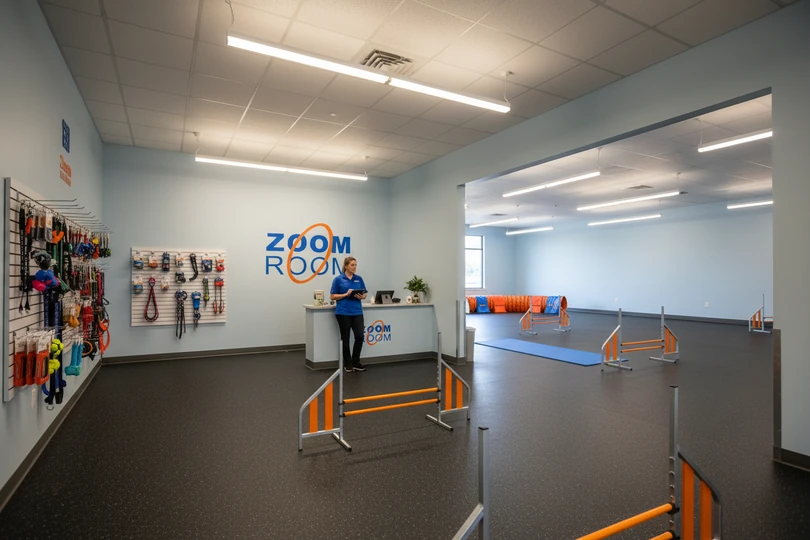
Contrast that with an owner-participatory model. At Zoom Room, franchise owners are in the room. They are working with dogs and people. The business is socialization-first dog training built on positive reinforcement. Owners are not sitting in a back office watching spreadsheets. They are building real relationships with their community, and they get to do it alongside their own dogs.
Think about what specifically you want your days to look like. Then work backward to find the franchise category and model that matches. Do you want to be in a retail space interacting with customers? Managing a team from a distance? Building a B2B operation? The franchise world is huge, and the right fit depends entirely on what "better" means to you.
How to Know If You're Ready
Readiness is not just financial. It is emotional and practical. Ask yourself these questions honestly:
Are you prepared to earn less in year one than you do now? Most new franchise owners reinvest early revenue into growth. The payoff comes later, but the early phase requires patience. Do you have support at home? A spouse, partner, or family who understands the transition matters more than most people realize. Emily and Brad Weaner opened their Zoom Room location in Centerville, Ohio, in 2023 as a team, and having a partner who shares the vision makes the hard days manageable.
Can you follow a system even when you think you know better? Franchising works because the playbook is proven. Your corporate instinct to "improve the process" is great, but only after you have mastered the system as designed. Are you doing this because you want to build something, or because you want to escape something? Both can be true, but the builders tend to succeed at a higher rate.
The Bottom Line: Hate Is Not a Strategy, but It Can Be a Catalyst
If you hate your corporate job, that feeling is information. It is telling you something important about what you need. Franchise ownership can absolutely be the answer, but only if you approach it with clarity, planning, and self-awareness.
The corporate-to-franchise pipeline is well-worn for a reason. The skills transfer. The systems are designed for people like you. And the reward of building something that is yours, something connected to your community and your values, is real.
Start by researching franchise categories that match your interests and lifestyle goals. Read FDDs. Talk to existing franchisees. And give yourself permission to imagine a different kind of work life. The Sunday-night dread does not have to be permanent.
Frequently Asked Questions
- Beyond your franchise investment, plan for 6 to 12 months of personal living expenses as a safety net. The total franchise investment varies by concept, but the FDD will break down every cost. Many corporate professionals use SBA loans or ROBS programs to fund their investment without draining savings.
- In most cases, yes. Year one is about building the business, training your team, and establishing your customer base. Most franchise owners reinvest early revenue into growth. The financial upside of franchise ownership tends to build over time as the business matures and generates recurring revenue.
- Project management, team leadership, financial literacy, marketing strategy, and customer relationship skills all transfer directly. If you have managed budgets, led teams, or launched initiatives, you are better prepared than you think. The biggest shift is moving from an employee mindset to an owner mindset.
- After. Most franchise development processes take 3 to 6 months from initial research to signing. You can do the research, attend discovery days, and secure financing while still employed. Time your exit for when you need to be fully present for training and buildout.
- Pet franchises can be an excellent fit, especially for people who want a business connected to a personal passion. The pet industry has shown consistent growth regardless of economic conditions. Concepts like Zoom Room offer owner-participatory models where you are genuinely involved in the work, not just managing from a distance.
How much money do I need saved before leaving corporate for a franchise? +
Will I take a pay cut in year one of franchise ownership? +
What corporate skills transfer best to franchise ownership? +
Should I quit my job before or after buying a franchise? +
Are pet franchises a good option for corporate refugees? +
Ready to Explore What's Next?
Zoom Room is a socialization-first dog training franchise with Fortune 500 leadership and a model built for people leaving corporate careers. Learn how your skills can transfer to building something of your own.
Request InfoThis is not an offer to sell a franchise. An offer can only be made through a Franchise Disclosure Document. Financial performance representations are available in Item 19 of our Franchise Disclosure Document. Contact us to request our FDD.