
Best Franchises Under $100K: What You Can Actually Build at This Investment Level
A sub-$100K franchise investment is real, but it comes with trade-offs that most listicles won't mention. At this price point, you're typically buying into home-based, mobile, or service models that trade lower startup costs for higher personal involvement. Here is an honest look at what works, what doesn't, and how to evaluate your options.
What $100K Actually Buys in Franchising
At this investment level, you're generally looking at businesses without a brick-and-mortar location. That means home-based operations, mobile service vehicles, or consultant-style models where the franchise system provides branding, training, and operational support while you provide the labor and hustle.
The franchise fee itself will typically consume $20,000 to $50,000 of your budget, leaving the remainder for equipment, initial marketing, working capital, and vehicle wraps or mobile buildouts. This is not the territory of flagship retail locations or premium service centers. Understanding that distinction upfront is important because it shapes your revenue ceiling, your daily routine, and your growth trajectory.
That said, some of the most financially efficient franchise models in America operate at this level. Lower overhead means you can reach profitability faster, and many franchisees in this bracket report positive cash flow within their first year of operation.
Home Services: The Dominant Category Under $100K
Home cleaning, carpet cleaning, junk removal, handyman services, and lawn care franchises dominate this investment range. Brands in these categories typically require $50,000 to $90,000 total investment, including a franchise fee between $20,000 and $40,000.
The appeal is straightforward: homeowners always need maintenance, the services are not easily replaced by technology, and the recurring nature of cleaning and lawn care creates predictable revenue streams. A well-run home cleaning franchise can build a roster of 30 to 50 recurring clients within 18 months, creating a foundation of reliable monthly income.
The reality check: you will likely start by doing the work yourself or managing a very small crew. Recruiting and retaining reliable workers is the single biggest challenge franchisees cite in this category. The work can be physically demanding, and customer expectations for quality and reliability are high. Profit margins are attractive on paper, often 30 to 50 percent, but labor issues can erode those margins quickly.
Mobile and Service-Based Concepts
Mobile pet grooming, mobile auto detailing, mosquito and pest control, and fitness coaching are all categories where franchises operate under $100K. These models use wrapped vehicles or trailers as their primary business platform, bringing the service directly to the customer.
The mobile model has genuine advantages: no lease payments, no buildout costs, and the ability to serve a wide geographic area. A mobile pet grooming franchise, for example, can cover an entire suburban county from a single vehicle. The investment typically ranges from $60,000 to $95,000 including the vehicle buildout.
The constraint is scalability. Each unit of growth requires another vehicle, another operator, and another set of scheduling logistics. You're building a fleet business, not a destination business. That's a fundamentally different management challenge than running a single location where customers come to you.
Consulting and B2B Franchises
Business coaching, marketing services, staffing, and consulting franchises can operate under $100K because the primary asset is expertise rather than equipment or real estate. These models work well for professionals leaving corporate careers who have industry knowledge and a network of contacts.
The economics can be compelling. A single B2B client contract might be worth $2,000 to $10,000 per month, so building a roster of five to ten clients can generate meaningful revenue. The margins are high because the overhead is low, often just a home office, a laptop, and a phone.
The challenge is sales. B2B franchises require a franchisee who is comfortable with business development, networking, and selling. The franchise system provides methodologies and brand credibility, but closing deals still depends heavily on the individual owner. If you're leaving corporate because you're tired of selling, a consulting franchise is probably not the right fit.
What to Watch Out For at This Price Point
Low investment does not mean low risk. In fact, undercapitalization is one of the top reasons franchises fail. If a franchise requires $80,000 and you have exactly $80,000, you're setting yourself up for problems. You need working capital to cover months of operating expenses before revenue stabilizes.
Be cautious of franchise systems that seem unusually cheap. A $15,000 franchise fee might signal a brand that hasn't invested in the support infrastructure that makes franchising valuable in the first place. Ask what you're getting for the fee: training quality, marketing support, technology platforms, and ongoing coaching all cost money to provide.
Also scrutinize the royalty structure. Some low-cost franchises compensate with aggressive ongoing royalties of 8 to 12 percent, mandatory vendor purchases at above-market prices, or required marketing spend that doesn't generate local leads. Calculate the total annual cost of being in the system, not just the entry price.
When to Spend More: The Case for Stepping Up
The honest truth about sub-$100K franchises is that many successful franchise owners eventually wish they had started at a higher investment level. A brick-and-mortar location provides customer credibility, a consistent brand experience, and a physical asset that can be resold. Home-based and mobile businesses often depend heavily on the owner's personal reputation and effort, making them harder to sell or scale.
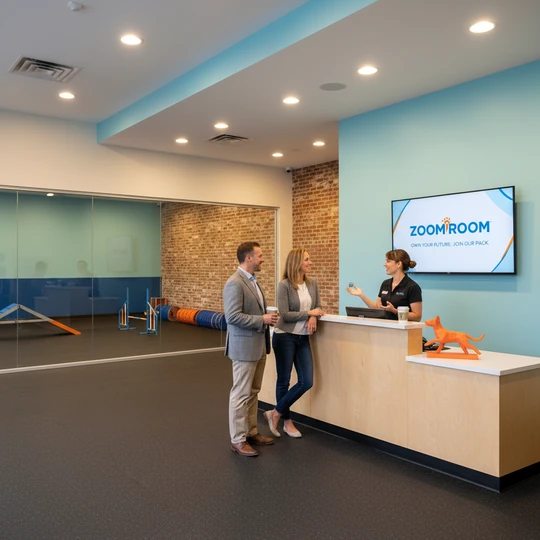
If you're deciding between a $90,000 home-based franchise and stretching to a $200,000 or $300,000 concept with a physical presence, the math might favor the larger investment. Pet services, specialty fitness, and education franchises in the $200,000 to $400,000 range often produce higher absolute returns and build more transferable business value. Zoom Room, for example, operates in the $302,000 to $465,000 range with a compact 3,000-square-foot footprint, but that investment buys a destination business with recurring class revenue and a recognizable presence in the community.
The right answer depends on your financial situation, risk tolerance, and long-term goals. A $75,000 franchise that you can fund without debt is arguably less risky than a $350,000 franchise that requires a full SBA loan, even if the larger concept has higher revenue potential.
Frequently Asked Questions
- Profitability depends more on the local market and the owner's execution than on the brand itself. Home services franchises (cleaning, lawn care, junk removal) often achieve the highest profit margins at this level because overhead is minimal and recurring revenue builds over time. B2B consulting franchises can also be highly profitable but depend on the owner's sales ability. Review Item 19 of the Franchise Disclosure Document for any brand you're evaluating to see actual financial performance data.
- Yes, though the options are concentrated in home-based, mobile, and service categories. Franchise fees at this level range from $15,000 to $50,000, with the remainder covering equipment, vehicles, initial marketing, and working capital. Be realistic about additional capital needs beyond the stated investment range, as most franchisees spend more than the minimum in their first year.
- Low cost does not automatically mean low quality, but it warrants extra scrutiny. Evaluate what the franchise fee actually pays for: training, technology, marketing systems, and ongoing support. A $30,000 franchise with excellent training and strong brand recognition can be a better investment than a $10,000 franchise that provides a manual and a logo. Focus on the total value proposition, not just the entry price.
- Most franchises at this level are designed for people without industry-specific experience. The franchise system provides training, operational procedures, and ongoing support. However, general business skills like customer service, basic financial management, and local marketing are valuable regardless of the concept. Some categories, like B2B consulting, work better with relevant professional experience.
- If you have the cash and it won't deplete your emergency reserves, self-funding avoids interest costs and simplifies the process. SBA loans are available for franchise purchases, typically requiring 10 to 20 percent down, but the overhead of debt service eats into margins that may already be thin at this investment level. Consider ROBS (Rollover for Business Startups) as another option if you have retirement funds. Each path has trade-offs worth discussing with a franchise-focused financial advisor.
What is the most profitable franchise under $100K? +
Can I really start a franchise with less than $100K? +
Are cheap franchises worth it? +
Do I need experience to run a sub-$100K franchise? +
Should I finance a franchise under $100K or pay cash? +
Exploring Franchise Ownership in the Pet Industry
If your budget allows for a higher-return concept, Zoom Room is the number one dog training franchise in America, ranked by Entrepreneur in 2026. With an investment starting at $302,000 and a compact operating model, it offers a path worth evaluating.
Request InfoThis is not an offer to sell a franchise. An offer can only be made through a Franchise Disclosure Document. Financial performance representations are available in Item 19 of our Franchise Disclosure Document. Contact us to request our FDD.